How Much Protein Do You Need Per Day to Build Muscle?
For most healthy adults who exercise, 1.4–2.0 grams of protein per kilogram of body weight per day is a commonly cited sports-nutrition range. That is approximately 0.64–0.91 grams per pound. It describes total daily protein from all foods and supplements, not an amount of protein powder to add on top of your meals.
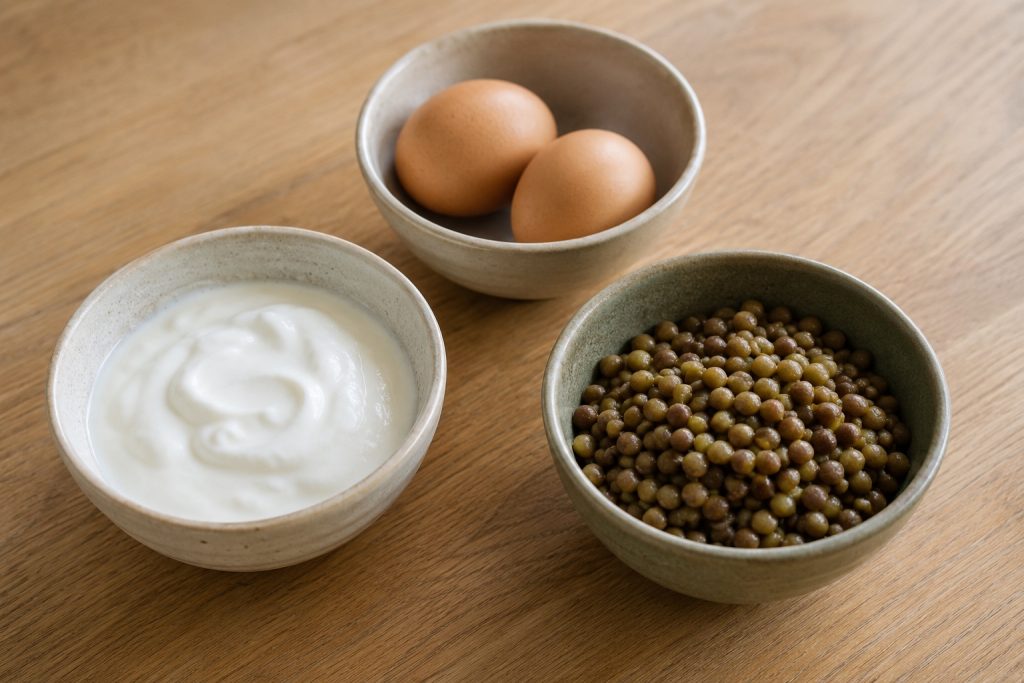
Where does the daily protein range come from?
The International Society of Sports Nutrition’s 2017 position stand describes this range as sufficient for most exercising individuals seeking to build or maintain muscle. It concerns healthy exercising people; it is not an individualized prescription for every age, health condition, or weight-management situation.
A 2018 meta-analysis by Morton and colleagues found that additional protein beyond approximately 1.6 g/kg/day did not provide further average gains in fat-free mass during resistance training in the analyzed data. That estimated breakpoint is not a precise personal ceiling, a safety limit, or evidence that every person needs exactly 1.6.
How do you calculate grams per day?
Convert pounds to kilograms if needed: divide pounds by approximately 2.205. Then multiply kilograms by the selected grams-per-kilogram figure. The examples below show the arithmetic for the published range and a 1.6 g/kg reference point; they are not meal prescriptions.
| Body weight | 1.4–2.0 g/kg/day | At 1.6 g/kg/day |
|---|---|---|
| Body weight 60 kg / about 132 lb |
1.4–2.0 g/kg/day 84–120 g |
At 1.6 g/kg/day 96 g |
| Body weight 70 kg / about 154 lb |
1.4–2.0 g/kg/day 98–140 g |
At 1.6 g/kg/day 112 g |
| Body weight 80 kg / about 176 lb |
1.4–2.0 g/kg/day 112–160 g |
At 1.6 g/kg/day 128 g |
| Body weight 90 kg / about 198 lb |
1.4–2.0 g/kg/day 126–180 g |
At 1.6 g/kg/day 144 g |
For example, 70 × 1.6 = 112. The result means 112 grams of the nutrient protein across the day. It does not mean 112 grams of chicken, yogurt, or powder; those foods contain other components too. Mixing up food weight and protein weight is an easy way to misread a target.
How can you compare that with what you already eat?
Start with a few ordinary meals and their actual labels or a reliable food-composition reference. Record the serving size you ate and the protein listed for that amount. If a label gives protein per serving and you eat half the serving, halve the figure; if it gives protein per 100 grams, scale it to the food weight.
As a purely arithmetic example, four eating occasions containing 25, 30, 20, and 35 grams sum to 110 grams. Those numbers demonstrate addition, not an optimized distribution or a menu. Use your own meals rather than assuming every bowl, scoop, or restaurant portion matches an internet example.
Do you need protein powder to reach the total?
A powder is one possible food product, not a required step in the calculation. Compare the convenience, serving information, price, and your preferences with other foods you already use. Read whether you need protein powder to build muscle before adding a supplement simply because you started lifting.
If you do use one, count the protein it provides within the daily total. “One scoop” is not a standard protein quantity across products. Check the product’s serving information rather than copying the scoop size from someone else’s routine.
Does more protein replace a better training plan?
The cited muscle-building evidence concerns protein in the context of resistance training. It does not turn protein intake alone into a complete plan. Keep your training record separate from your food arithmetic so you can identify what changed: sessions completed, loads and repetitions, or eating habits.
Use progressive overload to understand training progression, and rest-day planning to organize the week. There is little practical value in chasing a more precise daily number while the basic routine remains unclear.
When does the general calculation need individual advice?
If you have kidney disease, a prescribed protein restriction, or another condition affecting nutrition, do not apply this range without your clinician or registered dietitian. Pregnancy, adolescence, clinical nutrition needs, and complex weight-management goals also call for guidance beyond a general adult fitness article. A body-weight multiplication cannot account for those circumstances.
Compare protein sources
See our guide to plant and animal protein for muscle building for practical examples and the limits of the general guidance.
Translate the total into meals
See our guide to comparing actual protein-food portions for practical examples and the limits of the general guidance.
About this article: an introductory editorial draft. Not yet independently reviewed by a fitness professional.