Home Gym Equipment for Beginners: What Do You Actually Need?
A beginner home gym does not need a room full of machines. Start with a clear training space and a routine you can perform there. Add equipment when it solves a specific limitation—such as needing adjustable resistance for a planned exercise—rather than buying a bundle before you know what you will use.
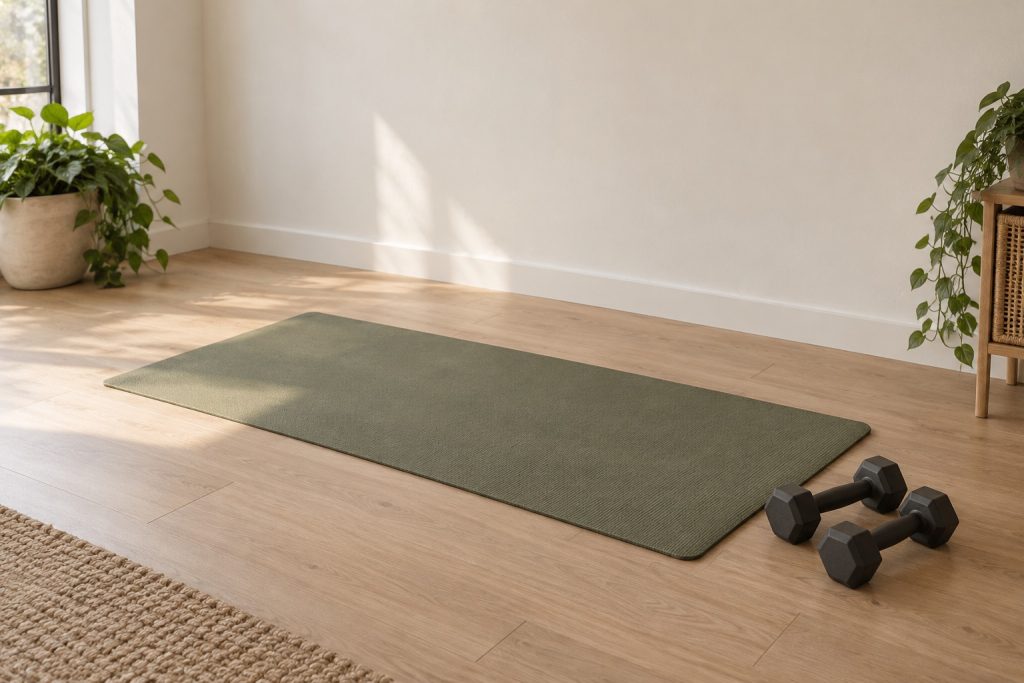
What should you decide before buying equipment?
Write down the movements in your intended routine, the space they require, and where everything will be stored afterward. Check whether the ceiling, floor, and surrounding furniture allow the entire movement. An item that fits in a cupboard may still require more working room than you expect.
Mayo Clinic notes that strength training can be done at home, using options such as bodyweight, resistance tubing, and free weights. Owning a machine is therefore not a prerequisite. The important buying question is which tool fits the exercise you intend to practice.
Which starter equipment serves which purpose?
| Option | Useful when | Check first |
|---|---|---|
| Bodyweight routine | You want to begin without storing weights | Whether each exercise has an appropriate variation for your current ability |
| Exercise mat | You want a designated surface for floor exercises | Grip, available floor area, and whether the mat stays flat |
| Resistance bands | Your program uses elastic resistance | Condition, resistance options, and the manufacturer’s setup instructions |
| Dumbbells | Your routine calls for external weights | Suitable load choices, storage, and secure adjustment mechanisms if adjustable |
| Bench or larger equipment | A specific exercise or program requires it | Working footprint, stability, rated capacity, and assembly requirements |
This is a decision checklist, not a ranking of products. A mat does not replace a suitable load, and a heavier dumbbell does not automatically make an exercise appropriate. See bodyweight exercises and resistance-band training for the underlying training options.
What does a minimal setup look like?
Imagine you have a small living-room corner and want to follow a beginner routine. First clear enough space to perform its movements without hitting furniture. If floor exercises are included, decide whether a mat improves comfort and grip. If the routine includes dumbbell movements, identify the load options it needs before purchasing a pair.
Keep the setup easy to repeat. A mat behind a door and weights in a stable, accessible storage spot may be more practical than equipment that requires moving several pieces of furniture every session. This is an organizational example, not a claim that one setup produces better results.
Should you buy fixed or adjustable dumbbells?
Compare the actual usable loads and increments, not just the largest number on the package. Ask whether you can make the changes required by your program and whether switching loads between exercises is practical. Try the adjustment process if possible, and read the manufacturer’s restrictions on handling and dropping.
Fixed dumbbells avoid a weight-changing mechanism but require more separate pieces if you need several loads. Adjustable designs combine loads in one system, with model-specific dimensions and locking arrangements. Neither choice tells you which starting weight is appropriate for a particular exercise.
What should you check before the first workout?
- Follow the equipment’s assembly, inspection, and loading instructions.
- Keep the exercise area and access route clear.
- Use purpose-designed attachment points as instructed; do not assume furniture or a door handle is a suitable anchor.
- Store weights where they cannot roll into a walkway or be easily disturbed by children or pets.
- Make sure you understand the exercise before increasing its resistance.
Which purchases can wait?
Wait on equipment that has no assigned role in your routine. Before a second purchase, finish the sentence: “I need this because my current setup cannot…” A specific answer helps you avoid duplicating something you already own.
A short workout log can reveal the limitation. If your problem is finding time rather than finding equipment, use the workout duration calculator and our guide to short workouts before expanding the setup.
Compare two common tools
See our guide to dumbbells versus kettlebells for practical examples and the limits of the general guidance.
Choose a dumbbell setup
See our guide to adjustable versus fixed dumbbells for practical examples and the limits of the general guidance.
Related reading
Home Gym Flooring vs Exercise Mats: What Protects the Floor?
Turn an equipment wish into a decision
Use these five prompts before comparing products. Write “unknown” where you still need an answer. A completed worksheet is a way to identify questions, not a safety certification or a reason to buy everything listed.
- Task: which named exercise or limitation would this item address, and can the current setup already address it?
- Usable resistance: which loads or band setup does the plan need now, and which changes are actually available? Record weight per item or per pair explicitly.
- Working space: where will the entire movement, setup and return happen? Check storage separately and follow the model’s instructions.
- Practical cost: include any required compatible parts, delivery, assembly and storage. Record maintenance and return conditions before comparing options.
- Decision: use what I have, clarify the plan, try an appropriate option, or buy after the unanswered questions are resolved?
Worked example: the largest weight is not the whole range
Two fictional adjustable dumbbells both advertise a maximum of 6 kg per dumbbell. One offers 2, 4 and 6 kg; the other offers 2, 3, 4, 5 and 6 kg. If an already agreed plan requires a 3 kg setting, the first cannot supply it just because its maximum is high enough. This example compares available settings; it does not recommend these weights or a one-kilogram progression.
Check whether the listed weight means one dumbbell, the pair, or the complete package. Also compare how the adjustment locks and how long changing it takes. Do not improvise unapproved attachments to create a missing setting. If the right exercise or starting load is still unclear, resolve that question before choosing a product.
Home equipment: printable decision sheet
Open the printable decision sheet
Open the sheet and use the browser’s Print command, or save the HTML file for later. Write on the printed copy; there is no online form or personal-data submission. The print layout separates the decision questions and comparison notes onto two sections.
Use one sheet for a specific training task. Answer the five questions, then compare up to two candidates against the same requirement. Keeping your current equipment is also an option.
Write “unknown” when information is missing and “not applicable” only when it truly does not apply. Record units, whether a weight is per item or per pair, and the date and source of each specification. A blank is not a zero cost or a passed check.
| What to record | Candidate A | Candidate B |
|---|---|---|
| Model, source and date checked | ________ | ________ |
| Usable loads or settings, with units | ________ | ________ |
| Working space and storage | ________ | ________ |
| Costs and what is included | ________ | ________ |
| Unresolved question and next action | ________ | ________ |
Decision and reason: use current equipment, clarify the plan, try a suitable option, or buy after resolving the questions. This worksheet does not approve equipment, installation or exercise suitability and does not produce a product score.
Decision / reason / next check
About this article: an introductory editorial draft. Not yet independently reviewed by a fitness professional.