Do Resistance Bands Work for Strength Training?
Yes. Resistance bands can improve strength, and research has found similar strength gains to conventional resistance equipment in the programs studied. That does not make every band workout equivalent to every weight routine. Exercise selection, effort, progression, and a repeatable setup still matter.
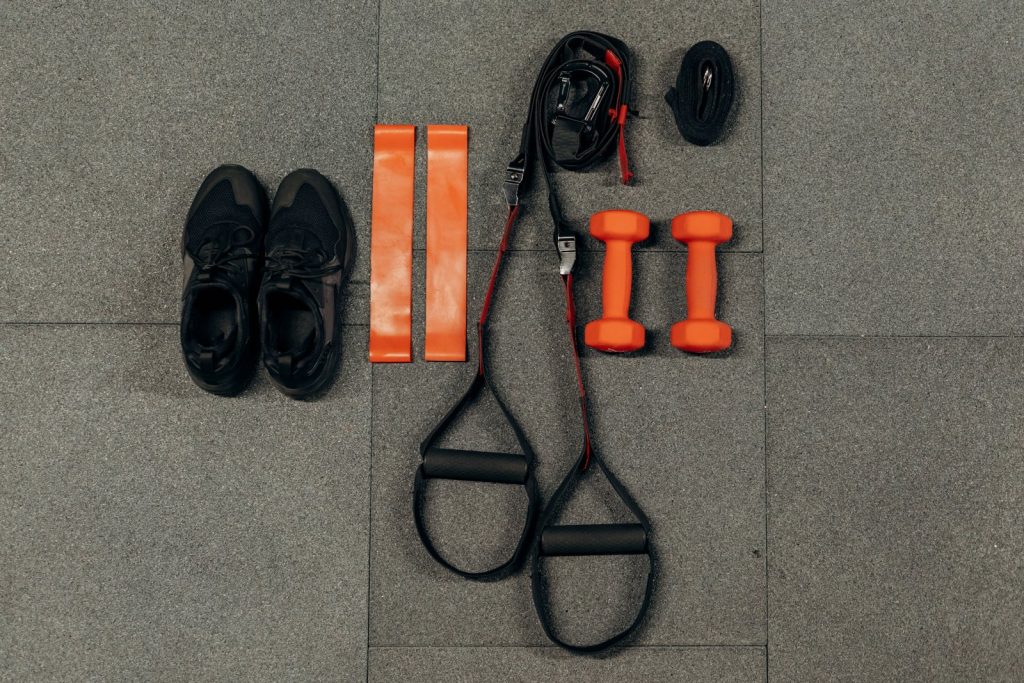
What evidence supports resistance bands?
A 2019 systematic review by Lopes and colleagues included eight studies comparing elastic resistance with conventional equipment. The pooled results did not establish superiority for either approach in upper- or lower-limb strength. The participants and training protocols varied, so the result does not certify any particular product or online workout.
The ACSM’s 2026 update also recognizes benefits from elastic bands and home-based resistance training. A gym membership is therefore not a prerequisite for useful strengthening exercise. The older comparison above concerned strength; it should not be presented as proof of identical muscle growth in all circumstances.
How do bands differ from dumbbells?
A dumbbell has a fixed labeled mass. A band’s resistance depends on its stretch and setup, so a printed resistance range is not a direct substitute for one dumbbell weight. Band colors and ratings also need to be interpreted using the particular manufacturer’s information.
| Detail | Band workout | Dumbbell workout |
|---|---|---|
| Equipment record | Brand, model, and band identifier | Mass of each dumbbell |
| Setup record | Anchor, grip, and starting position | Exercise and body position |
| Comparison | Repeat the same setup before comparing reps | Repeat the movement before comparing reps or load |
For example, “blue band, 12 reps” may be too vague to reproduce. “Brand A long blue loop, seated row, approved anchor at the marked height, same grip marks, 12 reps” creates a much more useful record. This is a logging example, not an instruction to improvise an anchor.
How can you track progress with bands?
- Give each band a recognizable label in your workout log.
- Record the setup and intended range of motion.
- Note completed sets, repetitions, and estimated effort.
- When the program changes the band or setup, record it as a change instead of treating the numbers as directly comparable.
If last week’s row used a shorter starting distance than this week’s, extra repetitions alone cannot tell the full story. Keeping a small setup note avoids attributing every difference to stronger muscles. Learn the general idea of progressive overload before deciding what to increase.
What should you check before using a band?
Follow the band’s instructions for compatible anchors, permitted stretch, inspection, and replacement. Do not assume furniture or a door handle is a suitable attachment point. Stop using equipment with damage or an uncertain connection, and learn the movement before increasing its difficulty.
Choose equipment around the exercises you can perform and repeat confidently. Bands are portable and compact; dumbbells may make load changes easier to label. You can also combine methods. Our machines versus free weights guide offers another comparison if you are assembling a broader routine.
Build a practical home setup
See our guide to home gym equipment for beginners for practical examples and the limits of the general guidance.
Identify your band level
See our guide to resistance band colors and ratings for practical examples and the limits of the general guidance.
Compare two resistance options
See our guide to cable machines versus resistance bands for practical examples and the limits of the general guidance.
Four questions before judging a band programme
- What is the goal: learn a movement, improve strength or something else? A study about strength does not establish every possible outcome.
- Which exercises are included, and can you repeat their intended movement with the specified equipment? A band set alone is not a training programme.
- What are the planned sets, repetitions or hold times, rest periods and effort? Record the instructions before judging whether you completed them.
- How does the programme handle an exercise that is too difficult or a planned progression? Ask for a clear adjustment rather than assuming that more stretch is always the next step.
Worked comparison: 30 repetitions can describe different sessions
These fictional entries explain a log, not a prescribed workout. Session A: the same band and row setup, 3 sets of 10 repetitions. Session B: the same equipment and setup, 2 sets of 15. Both total 30 repetitions: 3 × 10 = 30 and 2 × 15 = 30. They have different set lengths and numbers of rest breaks.
The total alone cannot establish equal difficulty, strength stimulus or readiness to progress. Keep the set-by-set entries, rest and effort notes. If the band or setup also changed, flag that separately. A package resistance range cannot turn these notes into an exact kilogram-volume comparison.
Five fields for reviewing the session
- Date, programme goal and exercise names.
- Reference to the band identification and repeatable setup note.
- Planned work and rest, kept separate from completed work.
- Actual repetitions or time for each set, rest, effort and any shortened or changed movement.
- What changed, what needs clarification, and the next step agreed in the programme.
Use the equipment guide for product identity and ratings, the workout log for actual sets, and the progression guide for the broader plan. A single log entry describes a session; it does not prove a training method worked or failed.
Band identity and ratings · Workout log · Progressive overload
About this article: an introductory editorial draft. Not yet independently reviewed by a fitness professional.