How to prepare a home workout space before each session
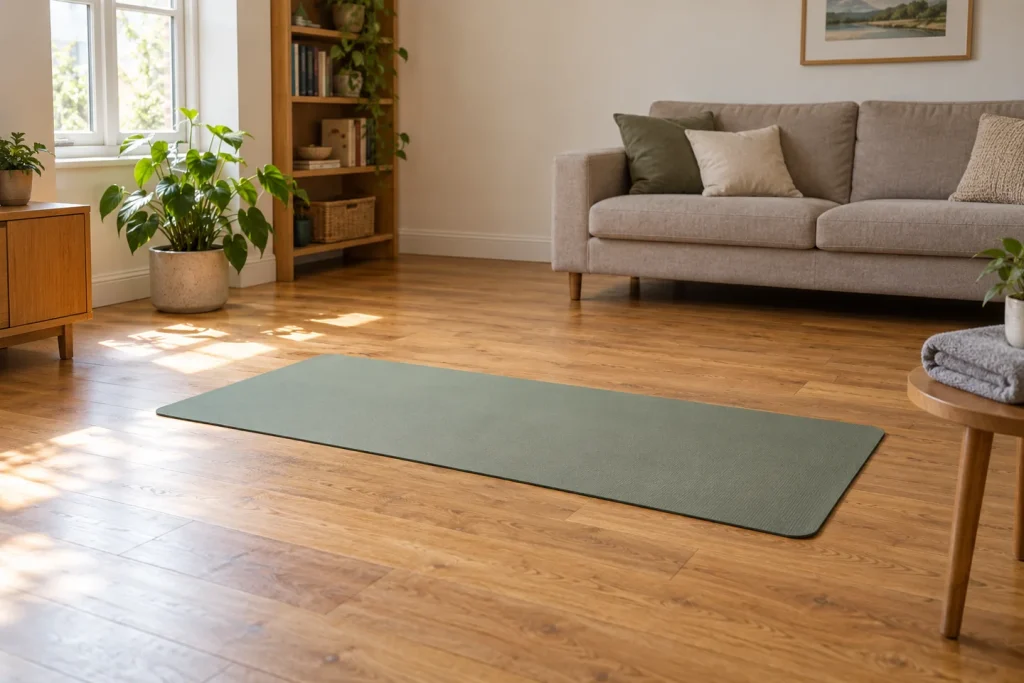
A home workout space is ready when it fits the movements you actually plan to do, lets you enter and leave freely, and keeps equipment and everyday household traffic apart. A mat fitting between the sofa and the wall does not establish that the workout fits. Check the room again when its layout or your exercises change.
Check movement space, not just floor area
Read the session first. Note whether it includes reaching overhead, stepping sideways, lying down, or moving an implement around your body. Consider the starting position, the whole movement, and how you will put equipment down. A ceiling light, opening door or table corner can matter even when the floor looks clear.
For familiar movements, check the required space without adding a load. This is a layout check, not proof that an exercise or support is suitable. If the movement does not fit, change the location or choose a suitable planned alternative; do not shorten or twist the movement just to avoid furniture.
The North Tees NHS advice highlights space, opening doors and furniture that could topple. The table below is our practical planning worksheet.
| Check | What to record or change |
|---|---|
| Movement area | Which planned movement needs the most room, including overhead? |
| Access | Can doors open and can people use an alternative route? |
| Surface | Remove loose objects and check for wet patches, slipping or curled mat edges. |
| Equipment | Check condition, setup and the manufacturer’s clearance instructions. |
| Screen | Place instructions where you can consult them between efforts without putting a device or cable underfoot. |
| Afterwards | Decide where each item goes before starting. |
Furniture is not automatically exercise equipment
A chair suitable for sitting may still be unsuitable for the exercise you intend. The NHS chair-exercise guidance specifies a stable, non-wheeled chair that will not slip. That guidance does not make every chair suitable for stepping, jumping or supporting external loads.
Use equipment according to its own instructions. This checklist cannot assess a floor’s structural capacity, certify a wall anchor or approve a doorway attachment. Do not improvise those checks from a photo. Follow model-specific requirements and obtain appropriate installation advice where needed.
Make a plan for a shared room
Tell others when the area is in use and arrange a route that does not cross your movement space. If you need to move furniture, count setup and reset in the time available. For example, a 25-minute slot with 3 minutes of setup and 2 minutes of packing away leaves 20 minutes for the session, including its preparation and rests.
Children should not play around moving equipment. The American Academy of Pediatrics advises supervision, unplugging unused machines and securely storing removable safety keys. Plan pet access too. A cleared room alone does not replace supervision.
Copy this setup-and-reset checklist
- Planned movements and required space checked.
- Floor and access routes clear; mat lies flat where used.
- Equipment inspected and set up according to its instructions.
- Household members know the area is in use.
- Instructions, timer and water placed outside the movement path.
- After the session: clean as directed, put equipment away, and restore the room’s usual access.
This is an organizational checklist, not an individual exercise prescription or a guarantee against injury. Recheck any item that changed rather than treating yesterday’s setup as permanent.
Related planning tools
Use the bodyweight guide to record the exact variation and compare sessions fairly.
Home workout space: setup and reset card
Use one copy for the room and session you actually plan. Read the full guide first. This card organizes a check; it does not certify equipment, anchors, floor capacity or exercise suitability.
Open the card, then use your browser’s Print command or save the HTML file for later. Write on the printed copy. There is no online form or personal-data submission.
Open the printable checklist · Download the HTML checklist
Tick only after checking. Leave an unresolved item unticked and note the action needed; mark a genuinely irrelevant item “not applicable”. A completed card is not a guarantee against injury. Recheck if the room, equipment or planned movements change.
Before the session
- The whole planned movement fits, including overhead reach and putting equipment down.
- The floor and access route are clear; the mat, if used, lies flat.
- Equipment condition, setup and clearance follow its own instructions.
- Other household members know the area is in use; child and pet access is arranged.
- Instructions, timer and water are outside the movement path.
After the session
- Clean and store equipment according to its instructions.
- Restore the room’s normal access and put loose items away.
- Record changed conditions or unresolved questions for the next session.
- Date / room / planned session
- ____
- Change needed before starting
- ____
- What to recheck next time
- ____
Example: “Door opens into the mat area — move the session to the other side of the room, then recheck the full movement.” The note names an action; it does not approve a cramped setup. Do not change the exercise unexpectedly just to tick the box.
About this article: an introductory editorial draft. Not yet independently reviewed by a fitness professional.