Stationary Bike Workouts for Beginners: Setup, Effort, and Progress
For a beginner stationary-bike workout, first learn the bike’s adjustment and stopping controls. Begin with manageable pedaling, judge effort as well as the display, and record a session you can repeat. There is no universal resistance number or minimum ride length that makes every indoor bike workout effective.
Choose the question you need to solve
How should you set up the bike?
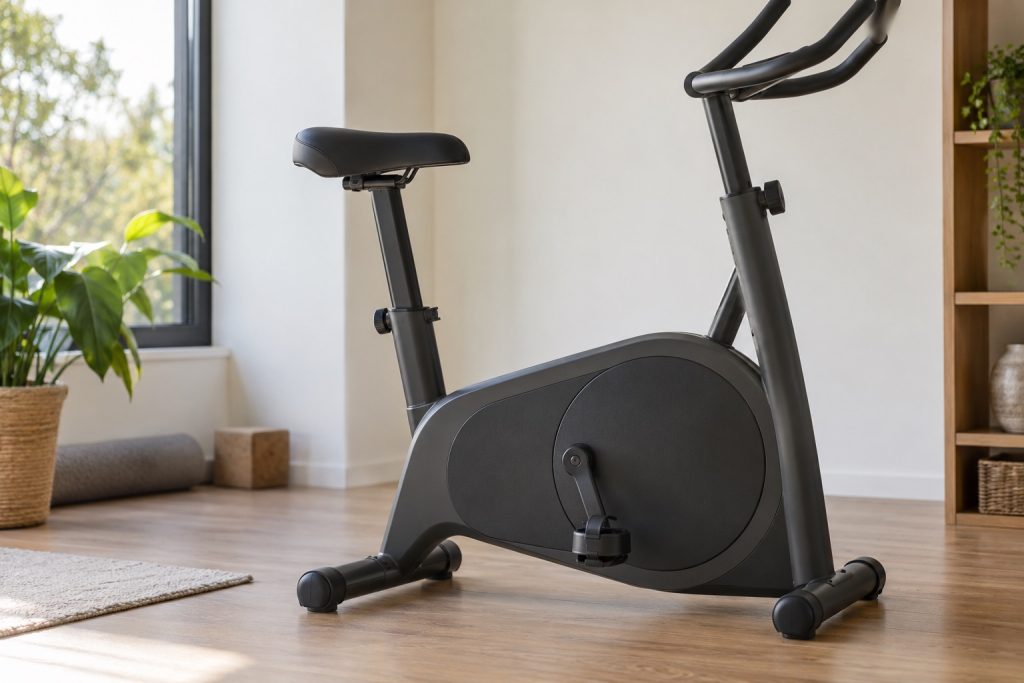
Hospital for Special Surgery’s bike-setup guide explains that fit is individual. Seat height, fore-and-aft position, and handlebar position interact. General setup cues are starting points, not proof that one configuration suits every rider.
Ask gym staff to show you the adjustments and stop mechanism for that model. Make changes while the bike is stationary and secure them according to its instructions. Do not assume two bikes of different designs use the same settings simply because their seats appear equally high.
Which display numbers matter?
| Display | What it usually describes |
|---|---|
| Time | How long the recorded session has run |
| Cadence / RPM | Pedal revolutions per minute |
| Resistance level | A model-specific setting, not a universal scale |
| Power / watts | Measured or estimated output, depending on the bike |
| Calories | An estimate rather than a direct measurement of your body’s energy use |
For your first records, time, the bike used, resistance setting, and perceived effort are often enough. A “level 5” session on one machine cannot automatically be compared with level 5 on another.
How hard should you pedal?
Choose the intended effort before increasing resistance. Mayo Clinic’s intensity guide describes using breathing and the talk test to help judge intensity. Our talk-test explainer gives the basic distinctions.
You do not need to imitate a high-intensity class during an independent beginner ride. If you cannot maintain controlled pedaling or a comfortable position, reduce the demand and reassess the setup. Persistent pain, dizziness, or unusual breathlessness is not a target to push through.
How can you organize a simple session?
Think in three parts: an easy start, a period at the intended manageable effort, and an easier finish. Let the length reflect what you can currently tolerate and any plan you are following. Record the time actually spent pedaling, not just the time between entering and leaving the gym.
A log might read “same bike, 12 minutes total, easy opening and finish, comfortable middle.” That is a record example, not a universal prescription. It provides enough context to repeat the outing before deciding whether to extend it.
Separate pedaling time from the whole visit
Here is a fictional completed session, not a recommended starting dose. The person recorded the middle block as moderate using their breathing and talk-test observations; the opening and finish stayed easy. The two-minute pause was off the bike.
| Part of the visit | Minutes | Recorded as |
|---|---|---|
| Setup before starting | 4 | Preparation |
| Easy opening | 3 | Easy pedaling |
| Middle block | 6 | Moderate pedaling in this example |
| Off-bike pause | 2 | Not pedaling |
| Easy finish | 3 | Easy pedaling |
Pedaling time is 3 + 6 + 3 = 12 minutes. From the start of pedaling to the end, the pause makes 14 elapsed minutes. Including the four-minute setup makes 18 minutes at the bike; changing and travel would add more. Only six minutes are classified as moderate here. A session label such as “12-minute ride” does not make every minute moderate.
Check whether that bike’s timer pauses when pedaling stops. If you do not know, record elapsed time and the pause separately rather than assuming the display means active time. If effort is uncertain, leave it unclassified; the arithmetic cannot determine intensity.
A five-field record for your next visit
- Date and bike identification: model, gym number or another clear description.
- Setup and mode: seat/handlebar markings, manual resistance or a programmed mode.
- Completed blocks: pedaling minutes, pauses and any changes to the intended session.
- Effort and display context: how the middle felt; resistance, cadence and watts only when available and clearly labelled.
- Next visit: repeat the reference session or note one planned change and why.
If you choose to add two minutes to the middle in a later session, keeping the easy three-minute opening and finish would give 3 + 8 + 3 = 14 pedaling minutes. That illustrates a time change, not a recommended progression rate. Do not automatically increase resistance and cadence too, and do not treat the longer duration as proof that the effort was otherwise identical.
If the usual bike is occupied, first learn the replacement bike’s controls and check the fit. Treat its first session as a new reference: matching a resistance number does not establish equal load. Do not chase an old watt value on an unfamiliar display. For the distinction between setting, cadence and power, read exercise-bike watts versus resistance.
Use the weekly activity guide to keep easy minutes, moderate minutes and pauses separate.
How should you increase the workout?
Change one planned feature at a time so you can interpret the result. Adding time, increasing resistance, and accelerating cadence together makes it difficult to know why a ride became harder. Keep a comparable reference session in your workout log.
If you later introduce harder and easier blocks, read interval versus continuous training. For combining cycling with lifting, see cardio before or after weights. The goal of an early ride is to establish a usable routine, not to maximize every number on the screen.
Choose a usable bike and setup
Start here if you are choosing equipment or cannot find a usable seated position. Separate the choice of machine from its adjustment: a comfortable category name does not tell you the right seat setting.
Plan one visit, then record what happened
If the bike and controls are familiar, stay on this page for the session example. It separates preparation, pedaling and pauses, then shows how to make the next visit comparable.
The example is a record to interpret, not a required duration. Before starting, decide what you mean by easy or moderate and use the effort discussion above; afterward, write what actually happened rather than replacing it with the intended plan.
Read the display without chasing every number
Use the question behind the number. Pedal turns, resistance settings and output describe different things; a single larger value does not explain the whole ride.
- Cadence versus speed: count pedal turns, understand zero-cadence periods and compare averages with the same time basis.
- Watts versus resistance: distinguish the machine’s setting from measured or estimated output, especially when changing bikes.
For example, “the display changed when I slowed my pedals” belongs to the watts/resistance explanation; “my ride average fell after a pause” belongs to cadence averaging. Neither question requires copying a stranger’s target number.
Printable exercise-bike session log
Open the printable bike session log
Open this HTML sheet, choose Print in your browser and inspect the A4 or Letter preview. You can also save the HTML file. Write on paper: this sheet has no online input fields and collects no personal data.
Use one sheet for one completed ride. Identify the bike and its settings before starting; fill in completed blocks, pauses and effort after the session. If you change machines midway, label the blocks for each machine separately.
Record pedaling time separately from off-bike pauses and preparation. Write the units shown beside any cadence or power value. Mark an unavailable measurement as unknown; do not enter zero unless it actually means zero. A blank field is not a failed workout.
Before comparing visits, check the machine, settings, timing basis and effort notes. A larger resistance number or longer ride alone does not prove the sessions were otherwise equivalent. The next-visit field is a planning note, not an instruction to increase the workload each time.
Setup context: Hospital for Special Surgery’s exercise-bike guidance.
About this article: an introductory editorial draft. Not yet independently reviewed by a fitness professional.