Stair Climber for Beginners: Find a Pace You Can Control
Start a stair-climber workout at a slow, controllable setting after learning the machine’s start and stop controls. Keep the first attempt short enough to practice stepping comfortably. There is no universal beginner level: the machine, your fitness, and how steadily you can move all matter.
What does a stair climber train?
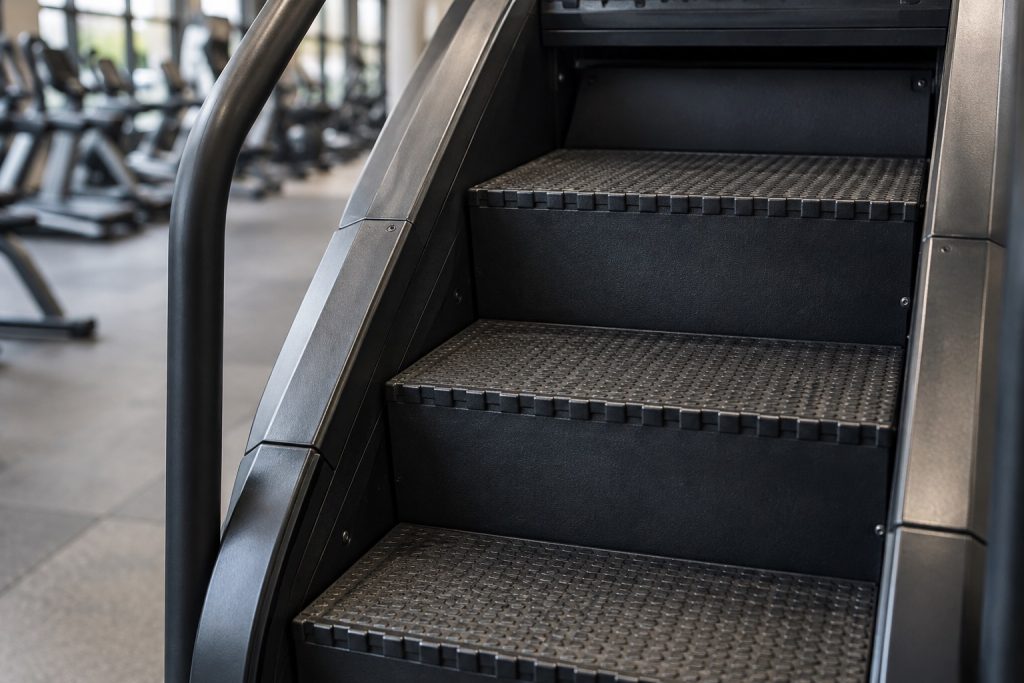
A rotating stair machine repeatedly presents steps as you climb in place. Cleveland Clinic’s stair-climbing guide describes both the aerobic demand and the work performed by the glutes, thighs, and calves. It can feel demanding quickly, even when the screen shows a modest speed.
Different machines use rotating stairs or separate stepping pedals. Ask staff which type you are using and how to get on and off safely. Instructions for one design may not transfer directly to another.
How should you approach the first session?
Locate the stop button before starting. Follow the equipment instructions for mounting, handrail use, and stopping; ask for a demonstration if anything is unclear. Choose a pace that lets you place each foot deliberately without scrambling to catch the next step.
As an illustrative practice format, try a brief easy bout, stop using the proper procedure, and assess whether another bout makes sense. A first visit can be a familiarization session. You do not need to reach a particular floor count or finish a challenge from social media.
Which level should a beginner use?
The lowest manageable setting is a starting point, not a test you must pass. Level numbers are model-specific. Record the machine and, if available, steps per minute alongside the level so your notes remain useful.
Use breathing and control as feedback. Our talk-test guide explains a simple way to describe aerobic effort. If the machine’s minimum pace still feels unmanageable, another cardio option may fit better.
How do you progress?
Keep one feature stable while changing another. For example, repeating the same short session more comfortably provides information before you add time. Changing speed, duration, and handrail support together makes comparisons difficult.
A useful log entry includes duration, setting, machine model, and perceived effort. Avoid treating estimated calories as a precise result; see the limits of exercise calorie estimates.
When should you choose another machine?
If stepping causes pain, you feel unsteady, or you cannot stop confidently, end the attempt and seek appropriate help. A stair climber is one option among many. Compare ellipticals and treadmills when choosing a routine you can repeat comfortably.
Practice a separate strength movement
See our guide to step-up setup and progression for practical examples and the limits of the general guidance.
Ask for a machine briefing before starting
Use these questions with gym staff while the machine is stopped. Follow the actual manual and demonstration; this checklist cannot supply the button sequence for your model.
- What is the exact model, and does it use moving stairs or separate pedals?
- How do I mount, use the handrails and dismount according to this machine’s instructions?
- Where are start, speed adjustment and stop, and what is the emergency-stop procedure? Ask what pause and resume do, if present.
- Which starting setting lets me place my feet steadily? If the minimum is still too fast, which alternative can I use?
Manufacturer example: the StairMaster 8Gx specification lists level settings and steps per minute separately and places speed/stop controls in the handrails. That description is specific to the 8Gx; verify your own machine. Core Health & Fitness 8Gx specification (French).
Read the display without turning it into a target
| Display or observation | What to put in your notes |
|---|---|
| Level | Record the number and model together. A level is not a universal effort score. |
| Steps per minute (SPM) | Copy the label and value if available. Keep it separate from level; do not invent a conversion. |
| Time | Record actual stepping time and pauses separately, with units. Do not silently substitute time spent learning the controls. |
| Effort and support | Describe breathing, steadiness and handrail use. Do not remove support merely to make the number look better. |
Copy a first-session note
- Date, machine model/type, controls explained: …
- Actual stepping time, pauses, level and SPM if shown: …
- Breathing, foot placement, handrail use, reason for stopping: …
- Next visit: repeat, ask for help or choose another activity; unresolved question: …
Example: ending a practice attempt is useful information
Alex learns the stop procedure with a staff member but feels rushed even at the minimum setting. Alex ends the attempt using the demonstrated procedure and asks about another cardio option. The note says “minimum setting felt too fast; stopped to regain a manageable task”, not “failed level one”. No extra minutes or harder setting are required to make this observation useful.
This is an illustrative decision, not an individual training prescription. Fill the note after stopping safely; leave unobserved fields marked “not recorded” rather than guessing.
Printable stair-climber first-session note
Open the printable first-session note
Open the sheet and use your browser’s Print command to print it or save it as PDF. It has four blank writing areas, saves no answers and needs no account.
Use one sheet for one attempt. Record the date, exact machine and what the staff member explained. After the attempt, add the actual stepping time and pauses, settings, observations and your next question.
Write “not shown” for an unavailable display value and “not checked” for a control you have not learned. A blank does not mean zero or that a check was passed. Keep level and steps per minute separate, and include time units.
Fill in the sheet only after safely stopping according to the equipment instructions. Keep your hands available for support while moving. This record does not prescribe a beginner level, duration or progression.
About this article: an introductory editorial draft. Not yet independently reviewed by a fitness professional.