Grams vs Milliliters on a Kitchen Scale
Grams measure mass; milliliters measure volume. A kitchen scale senses weight and may estimate liquid volume using an assumed density. Its milliliter mode does not directly measure how much space any ingredient occupies.
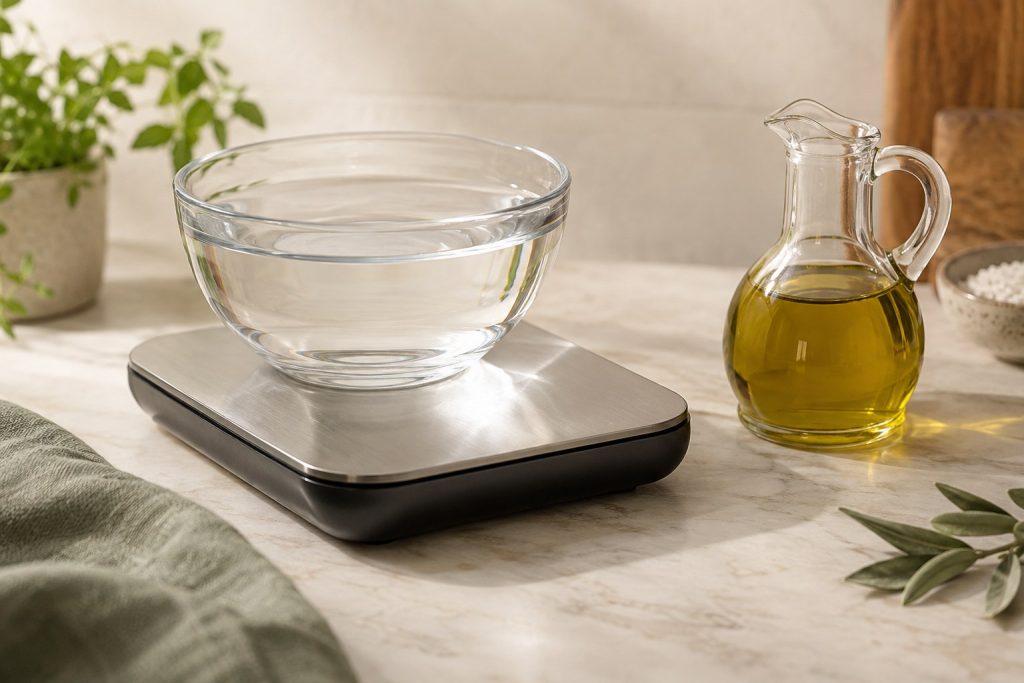
Check the liquid mode
Read the manual for your model. Salter describes some liquid modes as suitable for water-based liquids. That does not establish a universal conversion for oil, honey or flour. Separate water and milk settings, where present, use different assumptions.
Use the recipe’s unit
If a recipe gives grams, weigh that ingredient in grams after taring the container. If it gives milliliters, use a suitable measuring vessel or a manufacturer-supported liquid mode. Avoid changing units merely because the display offers them.
Do not generalize from water
Water is close to 1 g per 1 mL in ordinary kitchen conditions. That convenient approximation is not a rule for every food. A bowl of flour and an equal-volume bowl of water have different masses.
Keep food logging consistent
Use the unit and preparation state specified by the nutrition entry. Record grams when the entry uses grams; do not enter an oil volume as if it were the same mass. A scale’s resolution also limits precision for very small amounts.
Sources
Related reading
About this article: an introductory editorial draft. Not yet independently reviewed by a fitness professional.