Must a Table Tennis Serve Go Diagonally?
In standard standing table tennis, a singles serve does not have to go diagonally. A doubles serve must bounce in the server’s right half and then the receiver’s right half. In both cases, it first touches the server’s side.
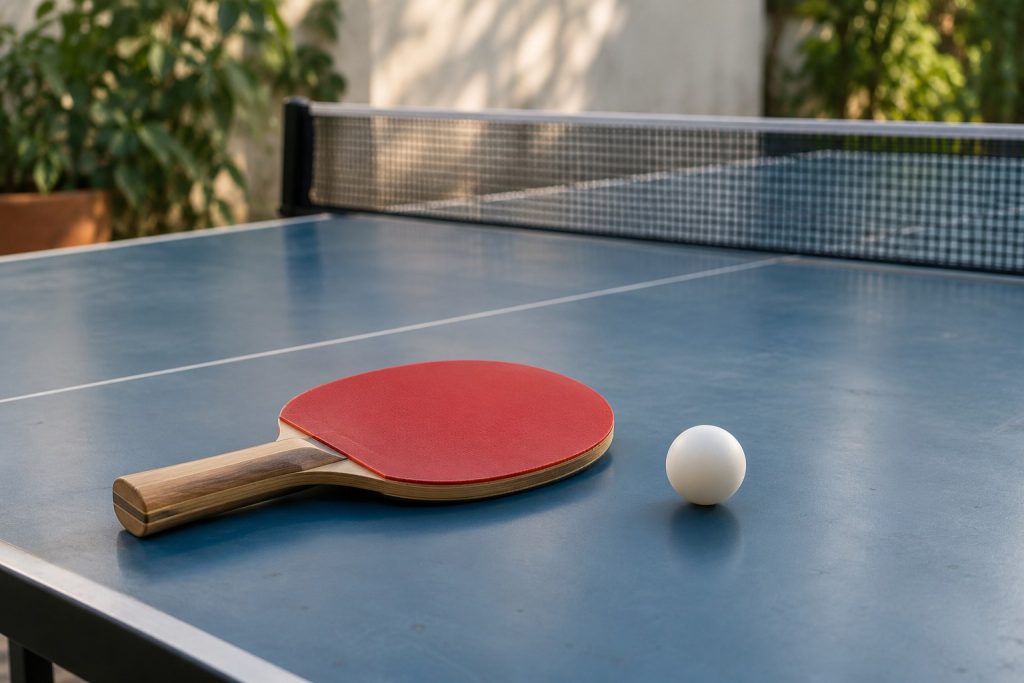
Singles: the center line does not restrict placement
A legal singles serve can land anywhere on the opponent’s playing surface after bouncing on the server’s side. It may travel diagonally or straight. The center line is not a boundary dividing legal singles service boxes.
Doubles: right half to right half
For doubles, the first bounce must be in the server’s right half-court and the next in the receiver’s right half-court. That makes the serve diagonal. Do not copy a tennis-style routine of alternating left and right service boxes.
Placement is only part of a legal serve
Start with the ball resting freely on an open, stationary palm. Toss it near vertically without imparting spin, at least 16 cm, and strike it as it falls. Until struck, it must stay above the playing surface, behind the end line and visible to the receiver; correct placement alone does not make a hidden serve legal.
The rally does not stay diagonal
After the serve, ordinary returns do not have to follow that diagonal. In doubles, partners must take turns hitting the ball. Practice the serve’s bounce pattern separately from the hitting order so these different rules do not become confused.
Sources
Table Tennis England; Table Tennis England — Laws.
Related reading
What Does 40+ Mean on a Table Tennis Ball?
What Does Non-Marking Mean on Indoor Court Shoes?
Related reading
Must a Table Tennis Paddle Be Red and Black?
Related reading
Table Tennis Edge Ball or Side Ball: Does It Count?
Related reading
About this article: an introductory editorial draft. Not yet independently reviewed by a fitness professional.