Dumbbells vs. Barbells: Which Should You Use?
Choose dumbbells or a barbell for a particular exercise and setting, not as a permanent identity. Start with the equipment you can set up, move and put away with control. Use the worksheet below to compare the available starting load, space, next weight increment and what you will record.
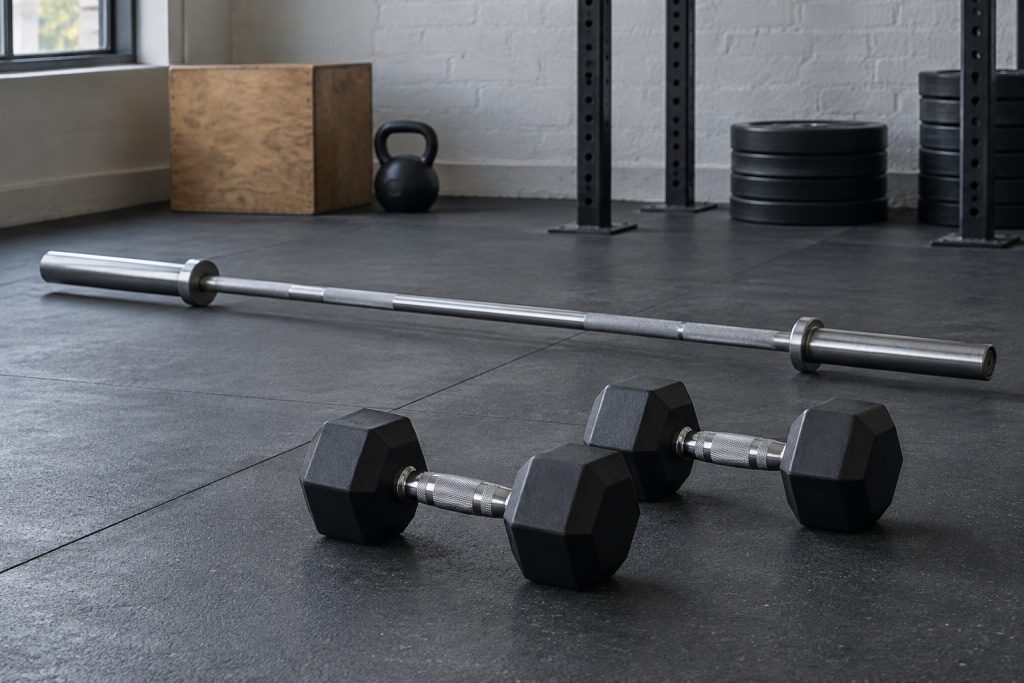
What changes with the equipment?
Mayo Clinic includes both dumbbells and barbells among free-weight options. The equipment label alone does not determine whether an exercise suits you.
Mayo Clinic: strength-training options.
| Question | Dumbbells | Barbell |
|---|---|---|
| What do the hands hold? | Usually separate implements, which can move independently. | Usually one connected implement. |
| What is the starting load? | Read each dumbbell’s label; specify one or two. | Check the actual bar mass; an empty bar is already a load. |
| How does loading change? | Change the pair or adjust each dumbbell according to its instructions. | Use matching plate loads on the two ends. |
| What space is needed? | Include pickup, movement and a place to put them down. | Include the bar ends, plate loading, movement and any rack. |
Make the first choice
For a first practice, identify the exact movement and learn its complete setup and finish. A light dumbbell can be an option when the available bar is too heavy. A barbell can suit someone learning a specific barbell lift with appropriate instruction and equipment. Neither example means one tool is always easier. If you cannot explain how you will finish a set and put the equipment down, ask for instruction before adding load.
Check the equipment’s adjustment or locking instructions and use the appropriate rack or safety arrangements for the exercise. Stop an exercise that causes pain. Choosing dumbbells instead of a barbell is not, by itself, a solution for an injury. A manageable unloaded or lighter practice can help you learn the task without committing to the old working weight.
Do equal totals mean equal exercises?
No. Two 20 lb dumbbells have a combined mass of 40 lb, but that is not a prescription to use them instead of a 40 lb barbell. Grip, range, starting position and control demands can change. CrossFit’s dumbbell guide also describes conversion as context-dependent rather than a fixed rule. Establish the new exercise separately; do not use a percentage chart as a readiness test.
CrossFit dumbbell guide: conversion notes, page 27.
Check the next increment
Look at what is actually available. Going from 10 to 12.5 lb per dumbbell adds 2.5 lb to each and 5 lb to the pair: (12.5 − 10) ÷ 10 × 100 = 25%. Adding one 0.5 kg plate to each end of a 20 kg bar makes 21 kg: 1 ÷ 20 × 100 = 5%. These are arithmetic examples, not recommended jumps or comparable exercises. Small steps depend on compatible equipment and available matching plates; a barbell does not guarantee them.
Can you use both?
You can use one tool for one movement and another elsewhere in the plan. Keep separate exercise names and comparable setups in your log. If the gym is busy, a tool change is also a task change: record it rather than pretending the session is identical. For home training, compare the complete space and storage requirements before assuming you need to buy both.
Your equipment-choice worksheet
Answer these six prompts for one exercise. An unanswered setup or finish question is a useful question for an instructor, not a score to pass. The card is a planning aid, not a prescription or equipment recommendation.
- Exercise and purpose: which exact movement am I learning?
- Available tool and load: one or two dumbbells, or bar plus plates; kg or lb?
- Setup and finish: where do I pick it up, start and put it down?
- Space and equipment: clear movement area, adjustments, rack or support needed?
- Next available increment: how much per dumbbell or per end, and how much total?
- After the attempt: actual repetitions, setup notes and what to keep or change next time?
Open the printable equipment-choice card
The HTML card repeats the six prompts and worked record with writing space. Open it and use your browser’s Print command, or save the HTML file for offline use. Choose paper size and check the print preview. It contains no form submission or tracking of your answers.
Worked load records
Record A: two 10 kg dumbbells, 8 then 7 repetitions, same exercise and setup. Write “2 × 10 kg; 8, 7”, keeping the per-dumbbell value visible. Record B: a different barbell exercise, 20 kg bar + 5 kg per end = 30 kg total, 6 then 6 repetitions. These entries describe different tasks; their totals do not show which session was better or how much weight to use next.
Related resources
About this article: an introductory editorial draft. Not yet independently reviewed by a fitness professional.