Chocolate Chips vs Chopped Chocolate: Why Cookies Change
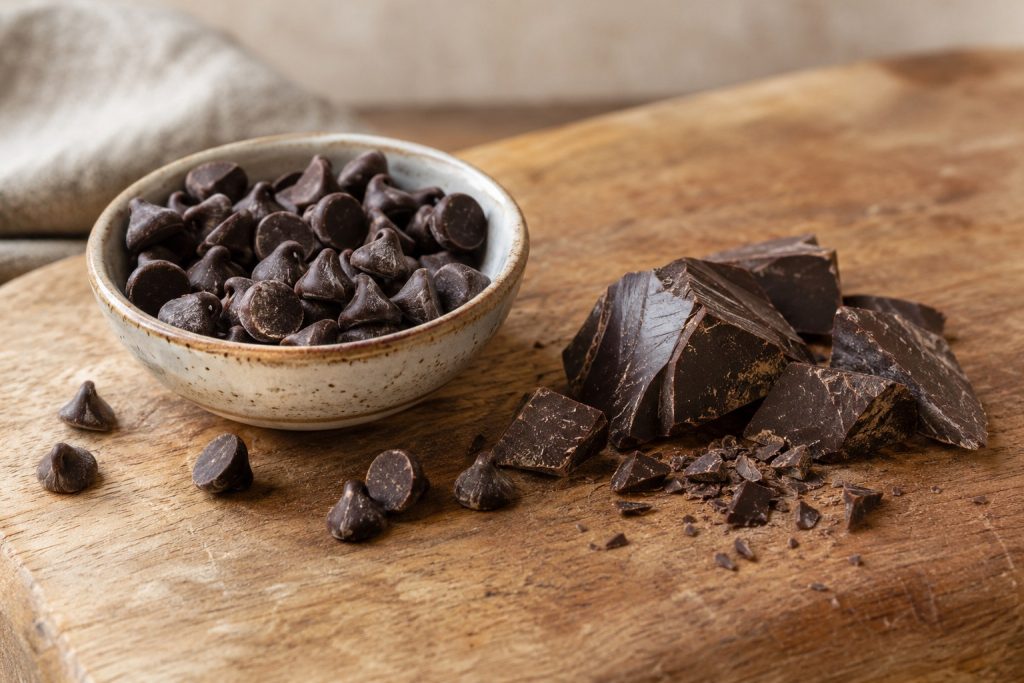
Chocolate chips often hold a recognizable shape in cookies, while chopped chocolate can create differently sized melted pockets. Formulation matters as well as shape. Choose the product your recipe specifies rather than assuming chips, bars and melting wafers all behave identically.
Start with the intended texture
King Arthur’s cookie guide describes how the choice of chocolate affects spread and texture. Uniform chips distribute differently from a mix of chopped chunks and fine shavings. Neither is universally better; decide what you want in the finished cookie.
Read the chocolate type
Check whether the product is unsweetened, semisweet, dark or milk chocolate and read the ingredients. Baking chocolate is not automatically unsweetened. Replacing one sweetness level with another changes the recipe even if both products are sold for baking.
Measure the replacement by weight
Follow the recipe’s amount and method. A cup of irregular chunks may not contain the same weight as a cup of small chips. When weights are provided, use them instead of assuming equal volumes are equivalent.
Do not assume chips cannot melt
Some chips melt smoothly, while others retain their shape more strongly during baking. For a sauce or coating, use a product and method intended for melting. Follow gentle heating instructions and avoid overheating in an attempt to force a particular texture.
Sources
King Arthur Baking; King Arthur Baking; King Arthur Baking.
Related reading
How to Use the Tare Button on a Kitchen Scale
Natural vs Dutch-Process Cocoa: Which Does Your Recipe Need?
Related reading
Parchment Paper vs Wax Paper: Which Can Line a Baking Sheet?
Related reading
What Does the Cacao Percentage on Chocolate Mean?
Related reading
Cacao Nibs vs Chocolate Chips: Expect a Different Bite
Related reading
About this article: an introductory editorial draft. Not yet independently reviewed by a fitness professional.