Strength Training at Home Without a Bench: What Can You Do?
You can strength train at home without a weight bench. Bodyweight exercises, standing dumbbell movements, and suitable floor exercises can cover many useful patterns. Choose exercises that fit your ability and space; a missing bench does not require turning unstable furniture into gym equipment.
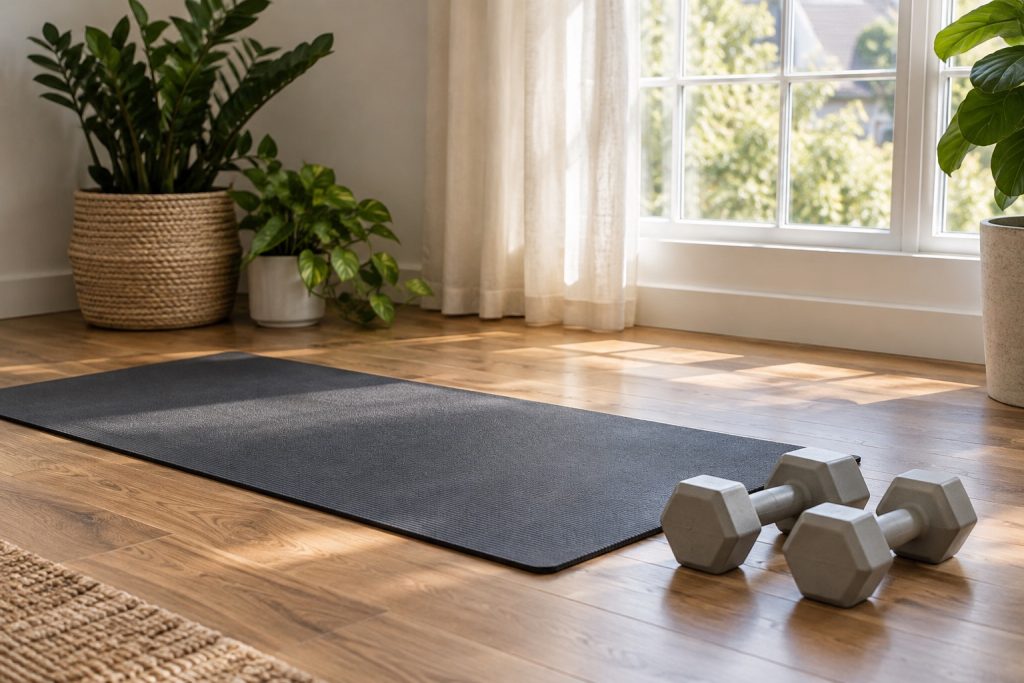
What equipment do you actually need?
Mayo Clinic describes bodyweight, free weights, and resistance tubing as strength-training options. A bench is helpful for certain exercises, but it is not a requirement for the entire activity.
Begin with clear floor space and a stable, non-slip surface. Add resistance only when it serves the movements you plan to use. If floor transfers are difficult, choose a standing routine or get help finding suitable alternatives rather than assuming all home sessions must happen on a mat.
Which movements could fit?
The table is a menu of possibilities, not a complete prescription or a technique tutorial. Select familiar versions you can control, and seek instruction for unfamiliar loaded movements.
| Movement idea | Possible option without a bench |
|---|---|
| Squat pattern | A comfortable bodyweight squat. |
| Hip hinge | A learned hinge pattern, with dumbbells when appropriate. |
| Upper-body push | A wall push-up or suitable floor push-up variation. |
| Upper-body pull | A controlled standing bent-over dumbbell row, if you know the setup. |
| Trunk control | A manageable floor exercise such as a dead bug. |
See hinges versus squats and beginner push-up variations for help interpreting the choices. The absence of a bench does not make every listed option suitable for every person.
Can a floor press replace a bench press?
A dumbbell floor press is a separate pressing variation. The floor limits how far the upper arms can travel down, so it does not reproduce the same range as a bench press. Choose a load you can position and put down safely, and learn the setup before increasing it.
If getting weights into position is the difficult part, a manageable push-up variation may be simpler. Do not treat a sofa, rolling chair, or narrow table as a substitute weight bench.
How do you organize a session?
Choose a small number of movements, decide the sets and effort in advance, and allow enough rest to repeat them with control. An illustrative plan might practice one squat, one hinge, one push, and one pull, with trunk work if appropriate. The exact workload should match your experience rather than fill an arbitrary timer.
How do you track progress without more equipment?
Record exercise variation, repetitions, load, and effort. Improve one variable at a time while keeping the movement comparable. Our progressive-overload guide explains why a repeatable plan is more useful than buying equipment simply to make the room look complete.
Compare pressing surfaces
See our guide to dumbbell floor presses versus bench presses for practical examples and the limits of the general guidance.
Related reading
Flat vs. Adjustable Weight Bench: Which Fits Your Training?
Choose the next step for your actual constraint
“No bench” describes equipment, not a complete training problem. First decide whether the missing piece is space, an unfamiliar exercise or an incomplete plan. Use the matching route; you do not need every linked exercise in one session.
I have not checked whether the session fits
Use the home-space checklist to check the whole movement, access and putting equipment away. A photo of a mat fitting in a room does not establish clearance. Leave with one change to make before starting.
My plan includes a bench press
Use the floor-press practice guide to understand floor contact, setup and the limits of comparing loads. If a push-up is the chosen alternative, use the beginner push-up guide for that variation. Record the replacement by its own name; do not silently keep the old bench-press entry.
I have exercises but no usable session
Use the strength-training learning path to resolve missing sets, rest and load instructions. Then use the workout log to record the work actually completed. The movement menu above is a choice aid, not a circuit to perform automatically.
Worked decision: a bench exercise in a room without a bench
An illustrative plan says “dumbbell bench press”, but the room has only a mat and dumbbells. First clarify whether the goal is practice of that exact lift or a general pressing movement. If the exact lift matters, resolve access to suitable equipment with the plan’s author. If a substitution is appropriate, agree the named alternative, its setup, load, repetitions and rest before beginning. A floor press may be one candidate, but a mat and two weights alone do not establish that it is suitable.
After the session, write the actual variation and completed work, plus what changed. Compare it with future entries of the same version. If you cannot set up or finish the alternative confidently, leave that question unresolved and seek instruction instead of improvising furniture support.
About this article: an introductory editorial draft. Not yet independently reviewed by a fitness professional.