Swimming for Fitness: How to Plan Your First Pool Sessions
Start swimming for fitness by matching the session to your swimming ability. If you are not confident in the water, begin with lessons rather than a lap target. If you can already swim safely, a short, manageable pool session with planned pauses can help you establish a repeatable routine.
Choose the guide for your next pool question
Start with the first-session questions below if you need to clarify your ability or the assigned task. Once the instruction is agreed, choose the resource that answers the specific gap in your plan or record.
Clarify the first session with five questions
- Sharing a lane
- Check entry, direction, passing and where to pause; the facility’s instructions come first.
- Counting completed distance
- Separate one-way lengths from laps, metres from yards and completed work from the written plan.
- Reading the pool clock
- Track minutes as well as seconds so a repeated clock mark does not hide elapsed time.
- Recording starts, finishes and distance
- Distinguish fixed rest from send-off times, then open the existing printable log to record what actually happened.
Use the resources in a practical order
- Before the visit: confirm the session and lane arrangements, then clarify the task with the instructor.
- Before timing: confirm the pool length, distance unit and clock reference. A distance calculation does not choose the task for you.
- After the task: record actual lengths, times and changes. Bring unresolved questions to the next visit.
Do you need lessons before a swimming workout?
Being comfortable standing in water is different from being able to swim, recover your breathing, and exit safely. The CDC’s drowning-prevention guidance emphasizes swimming skills and swimming with a buddy. Choose a supervised facility and follow its rules; a written workout cannot assess your water competence.
Tell an instructor what you can currently do rather than describing yourself only as “a beginner.” For example, you might be confident on your back but struggle to breathe during front crawl. That specific information is more useful for planning instruction than a desired calorie total.
What should you check before your first visit?
- Confirm public swim or lane-swimming hours and whether booking is required.
- Ask about pool length, depth, entry points, and lane etiquette.
- Bring the swimwear, towel, and other items required by the facility.
- Ask where a less experienced swimmer should start.
- Allow time for changing and showering as well as time in the water.
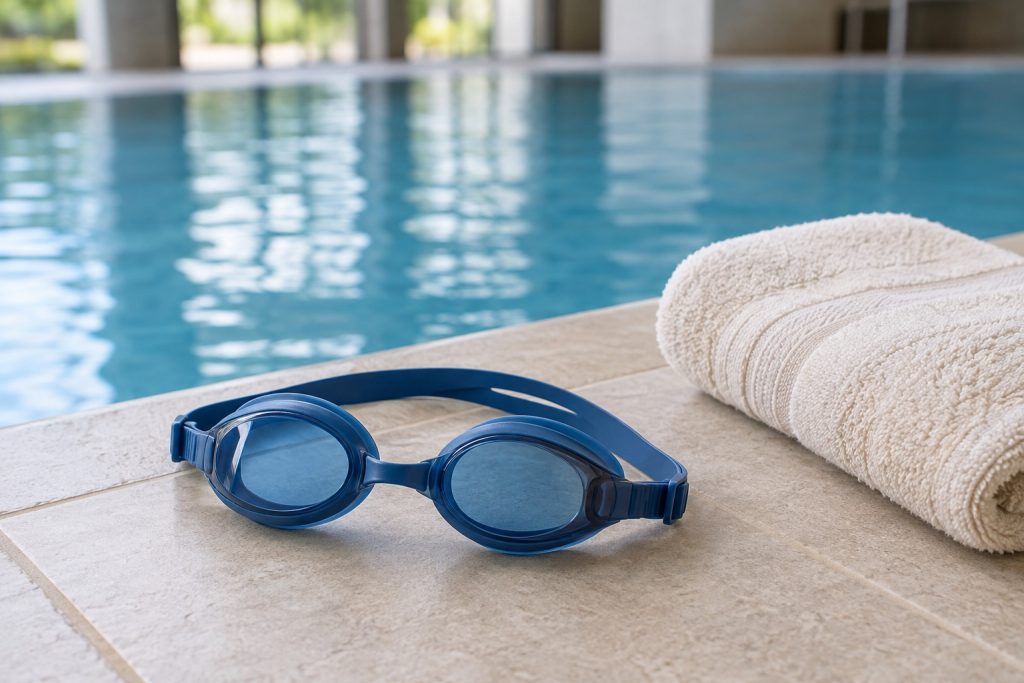
Goggles can help you see, but they are not a substitute for swimming skill. Equipment such as kickboards and fins also changes the task; use it as instructed rather than assuming every pool accessory makes an activity safer or easier.
How do you count swimming distance?
Use lengths of the pool and write down the pool’s actual length. “Lap” can mean different things to different swimmers. For a 25-meter pool, eight one-way lengths total 200 meters; in a 25-yard pool, eight lengths total 200 yards.
| Record | Example |
|---|---|
| Pool length | 25 meters |
| Lengths completed | 8 one-way lengths |
| Total distance | 8 × 25 = 200 meters |
| Timing method | Total session time including pauses, or swimming time only |
This is a counting example, not a recommended first-session distance. A suitable amount depends on your ability. Distinguishing swimming time from elapsed time makes later comparisons clearer.
Does swimming count as cardio?
The American Heart Association lists swimming among aerobic activities. How demanding a particular session is depends on what you do in the water; time spent changing, resting, or waiting for a lane is not the same as continuous swimming.
Keep your first records simple: what you practiced, what you completed comfortably, and what instruction you need next. Avoid comparing your pace with experienced swimmers before you can repeat your own technique reliably.
How should you plan the next visit?
Repeat a manageable format before changing distance, pace, stroke, and rest all at once. If technique breaks down, discuss it with an instructor instead of treating exhaustion as the goal. Swimming-related pain or unusual symptoms are reasons to stop and seek appropriate advice.
For the broader weekly plan, see adult activity guidance. If you are choosing an activity without repeated landings, compare low-impact exercise options. Keep a brief training log so each visit starts with something more useful than a guess.
Count your swimming distance
See our guide to pool lengths, laps, yards, and meters for practical examples and the limits of the general guidance.
Find comfortable equipment
See our guide to choosing swim goggles that fit for practical examples and the limits of the general guidance.
Explore a different pool session
See our guide to beginner water-aerobics classes for practical examples and the limits of the general guidance.
Related reading
Lap-Swimming Etiquette: How to Share a Pool Lane
Related reading
What Is a Center-Mount Swim Snorkel For?
Bring five questions to the first session
Use this brief with the instructor or pool staff before choosing a workout. It records agreed instructions; it is not a swimming-ability test or permission to swim alone.
- Current ability: what can I do comfortably, and where do I need teaching or assistance?
- Place and support: which session, area and entry/exit should I use, and who will explain the task?
- Exact task: what stroke or practice, distance unit and repeat count have we agreed? What does a length mean here?
- Pause and finish: when do I rest, when do I start again, and when does this task end?
- Next visit: what did I actually complete, what changed and which question should I bring back?
Example: clarify the task before counting it
A fictional instruction says “4 × 25, rest 20 seconds.” Before starting, confirm the unit, stroke, appropriate area and whether 20 seconds begins after each finish. In a 25 m pool, four completed one-way lengths total 100 m. If only three are completed, record 75 m and the reason the task changed. These figures explain notation; they do not establish a suitable first workout.
If you are unsure how to carry out the task, ask for teaching or a different agreed task. The record should describe what happened, not pressure you to finish an arbitrary number.
About this article: an introductory editorial draft. Not yet independently reviewed by a fitness professional.