Yoga Blocks for Beginners: Choosing and Using Support
Yoga blocks bring a supporting surface closer to you. They can reduce the distance your hand needs to reach or provide support in a position your instructor selects. Using a block is a way to adapt a pose; it is not a test of whether you are flexible enough to attend yoga.
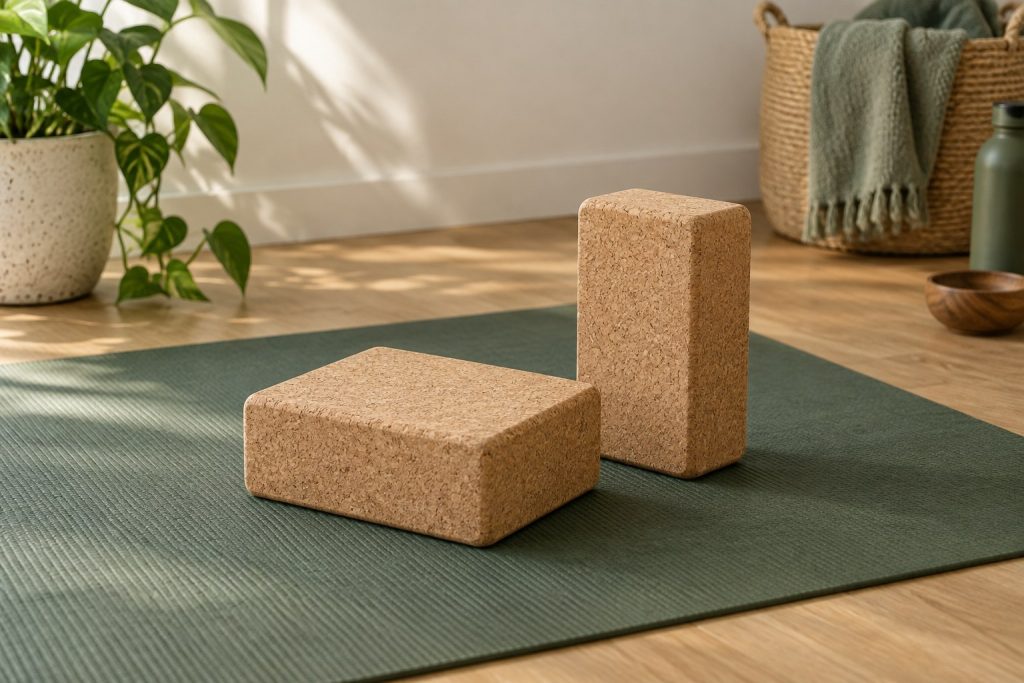
What does a yoga block change?
A rectangular block offers different heights when placed on different faces. The broad face gives the lowest, widest base; standing it on a smaller face raises the support. The tallest position is not automatically the best one for your balance or the pose.
ACE describes blocks as props that can extend reach and support positioning. Treat that as a reason to adjust the setup, not a reason to press farther into a stretch. Your body position and comfort still matter more than reaching a particular shape.
Foam or cork: what should you compare?
Compare firmness, grip, weight, dimensions, and how the edges feel under your hand. Foam and cork products vary, so the material name alone does not tell you how much a specific block will compress. Try the actual block when possible.
If a class uses a block under each hand, a matching pair makes the setup easier to reproduce. Borrowing the studio’s props for an introductory class can help you learn what you need before buying your own.
How do you set up a block?
Place it on a stable, nonslip surface, away from a mat edge or folded towel that could make it wobble. Ask the instructor which face to use and where the support belongs for that particular movement.
Do not build a tall stack to force a position you cannot comfortably control. If a setup feels unstable, reduce the challenge or choose another variation. Stop a position that causes sharp pain rather than trying a higher block to push through it.
Do beginners need blocks at home?
You only need the props used in the practice you plan to follow. Check the lesson’s equipment list and ask whether alternatives are suitable. A book or cushion does not automatically provide the same grip, shape, or load support.
After class, note which size and orientation worked. That gives you a practical shopping reference and a repeatable setup for the next session.
Sources
ACE.
Related reading
Stretching Strap vs. Resistance Band: Which Do You Need?
Mat Pilates vs. Reformer Pilates: A Beginner’s Guide
Related reading
About this article: an introductory editorial draft. Not yet independently reviewed by a fitness professional.