How Long Should a Strength Workout Last?
A strength workout does not have to last an hour to be useful. A focused 20- to 30-minute session can be worthwhile, while a plan with more exercises, sets, or longer rests will take more time. Estimate the duration from the work you need to complete instead of treating a particular number of minutes as the goal.
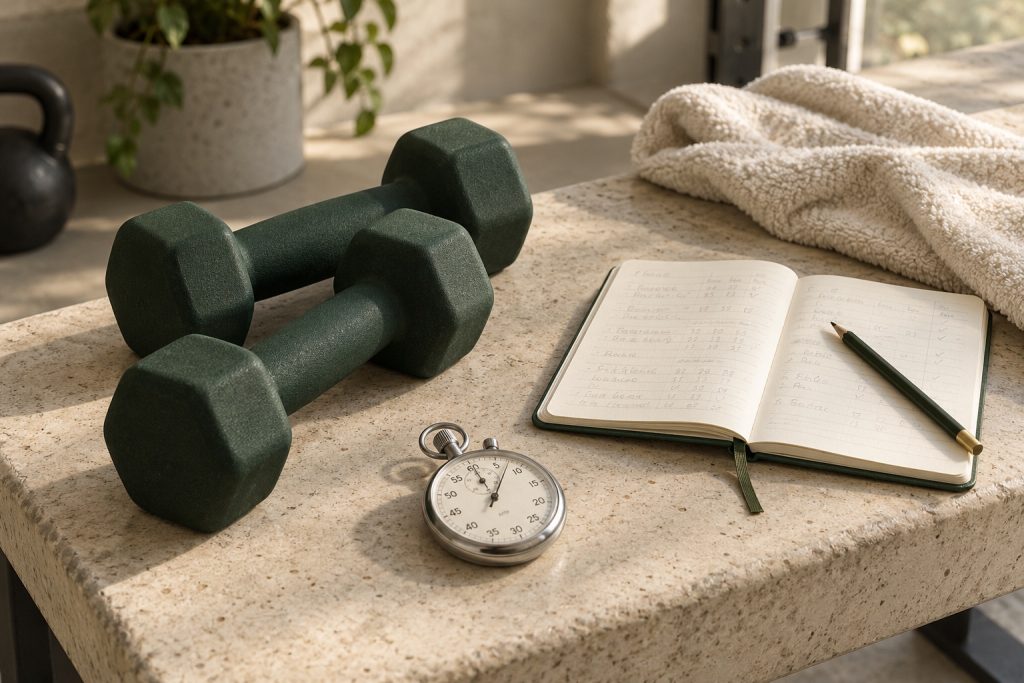
Is a 20-minute strength workout enough?
Mayo Clinic notes that two weekly strength sessions of about 20 to 30 minutes can improve strength. This is evidence-informed general guidance, not a promise that any 20-minute activity will deliver the same result or satisfy every training goal.
The CDC guidelines describe adult muscle strengthening in terms of days and major muscle groups, rather than a universal session length. A timer is useful for planning, but it does not tell you which muscles were trained or how demanding the exercise was.
How do you estimate the time a workout needs?
Break the session into preparation, working sets, planned rest, and equipment changes. If you are going to a gym, travel and changing time belong in your calendar too, even though they are not exercise time.
Here is an arithmetic example for budgeting, not a workout prescription. It assumes four exercises with two working sets each, 30 seconds per set, and one two-minute between-set rest per exercise. Your actual needs can be different.
| Component | Example time |
|---|---|
| General and exercise-specific preparation | 8 minutes |
| 8 working sets × 30 seconds | 4 minutes |
| 4 between-set rests × 2 minutes | 8 minutes |
| Equipment changes and other pauses | 6 minutes |
| Logging and finishing | 4 minutes |
| Total time reserved | 30 minutes |
Notice that most of the reservation is not spent performing repetitions. Preparation and rest are still part of the appointment. Use your own workout log to replace these illustrative numbers with realistic times.
Compare the estimate with one completed session
Use the same start and finish points for the estimate and the record. In this fictional straight-set session, the four exercises and eight working sets were completed as planned. Preparation and equipment changes took longer; the table does not assume that extra training work was added.
| Component | Planned minutes | Actual minutes |
|---|---|---|
| Preparation | 8 | 10 |
| Working sets | 4 | 4 |
| Between-set rest | 8 | 8 |
| Equipment changes and other pauses | 6 | 11 |
| Logging and finish | 4 | 4 |
| Total | 30 | 37 |
The estimate was 30 minutes; the record is 37. The seven-minute difference comes from preparation (+2) and equipment changes or pauses (+5), not longer working sets or between-set rests. These values describe this example only. Recording duration alone cannot establish that load, repetitions or technique were equivalent.
If the same visit also required 10 minutes of total travel and 6 minutes of changing, the calendar reservation was 53 minutes: 37 + 10 + 6. Keep these outside the session subtotal. A 30-minute free slot would not accommodate this particular visit.
Do not count the same minute twice. If an equipment change overlaps with recovery, record the elapsed interval once, not once as rest and again as a transition. In the original estimate, four exercises with two sets each have four within-exercise rest intervals; moves between exercises are accounted for separately. Warm-up sets belong in preparation or in their own exercise rows, not both.
Keep a five-field timing record
- Date, session version, start and finish points, and available calendar window.
- Planned and actual preparation, working-set, rest, transition and finishing minutes.
- Exercises, sets and repetitions actually completed; any additions or omissions.
- What caused the difference: setup, equipment queue, extra work or another interruption?
- One change to test next time, while keeping the plan’s training priorities clear.
For repeated overruns, review several ordinary visits before choosing a new allowance. An equipment queue suggests a different scheduling or equipment problem from extra sets. If the available window is fixed, agree a shorter version of the plan in advance rather than silently removing prescribed rest.
Use the existing workout duration calculator. Its straight-set estimate includes work, between-set rests and separate transitions. Update its assumptions from your record; it does not predict queues, travel or every form of circuit training.
What if your workouts keep running over time?
Identify the actual bottleneck first. Waiting for equipment, adding unplanned exercises, and discovering unfamiliar instructions midway through a session require different solutions. A longer workout does not automatically mean more useful training.
- If setup takes longer than expected, learn it in advance or allow for it.
- If the plan contains too much work for the appointment, ask which exercises have priority.
- If you add extra work spontaneously, log it separately so the original plan remains clear.
- If rest is part of the prescription, do not automatically erase it to hit a finish time.
Read rest between sets before assuming shorter pauses are always an improvement. Likewise, introducing supersets changes how work is arranged; it is not merely a faster way to run an otherwise identical session.
How should workout length fit into the week?
Start with the time you can reserve, then choose a suitable plan that fits it. Compare the weekly work as well as the session length: splitting an hour of scheduled training into two appointments changes the calendar, but does not by itself describe the exercises or their effects.
For scheduling examples, see how many days a week to lift weights. If daily commitments are the main obstacle, use our short-workout planning guide to protect a realistic training window.
Try the calculator
Plan your session with the workout duration calculator.
Put hydration advice in context
See our guide to whether you need electrolytes for a workout for practical examples and the limits of the general guidance.
About this article: an introductory editorial draft. Not yet independently reviewed by a fitness professional.