Aerobic Step Height: Measure the Platform, Not the Riser Count
An aerobic step’s working height is the distance from the floor to the top surface you step onto. Counting risers alone is unreliable across products. The deck, support design and permitted combinations all contribute to the final setup.
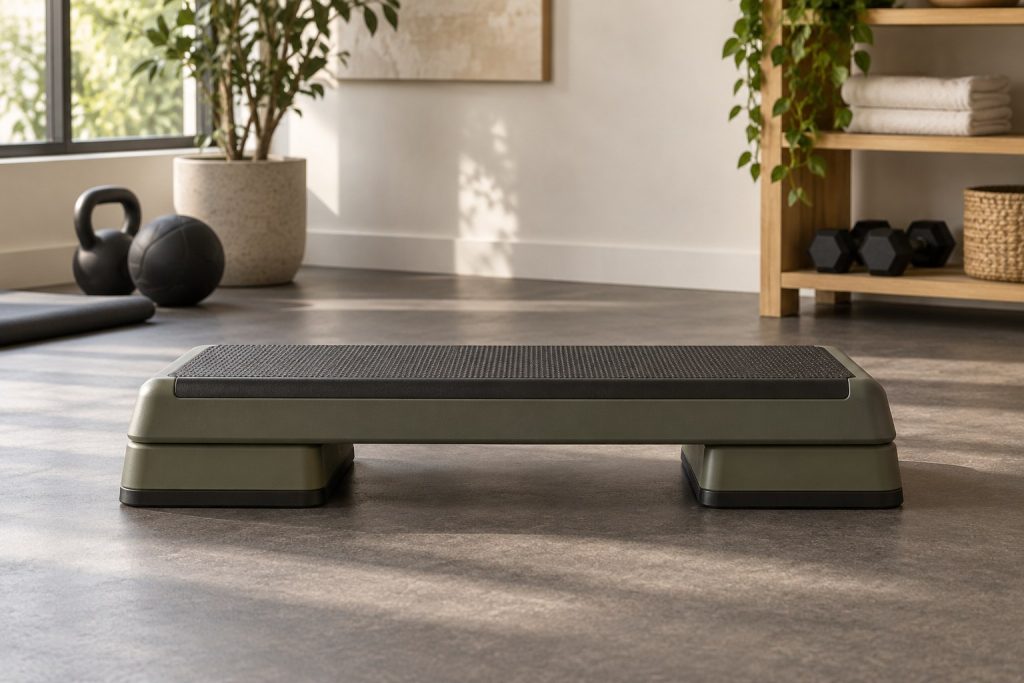
Read the assembled dimensions
The cited Reebok Step lists working heights of 15, 20 and 25 cm. Those are settings for that model, not a universal schedule for all platforms. Check whether another listing describes total height, a loose riser’s thickness or packed dimensions.
Match supports to the platform
Use supports designed and approved for the exact platform, following its locking instructions. Similar-looking blocks do not prove compatibility. For a level step setup, both ends should be supported as the manufacturer directs rather than balanced on improvised objects.
Check stability before starting
Place the step on a suitable stable surface and check that its supports are fully engaged. Follow the equipment’s user-weight and activity limits. A platform intended for stepping is not automatically approved for every jump, loaded exercise or bench-style use.
Choose height for controlled movement
Start with a setup you can use comfortably and with control, following your instructor’s plan when attending a class. More height is not automatically a better workout. Stop to change the configuration rather than adjusting supports while someone is using the platform.
Measure before you compare
- Identify the exact model and its permitted level configurations. Assemble and lock the supports as instructed, with nobody on the platform.
- Place it on its intended suitable, level surface. Hold a ruler or tape vertically beside the platform and read from that supporting surface to the top of the tread, not to the underside of the deck.
- Check both ends. If the platform rocks or the heights differ unexpectedly, stop and check the assembly and surface; do not solve the difference with improvised shims. Record the measurement in centimetres.
What does the number describe?
| Label or measurement | How to use it |
|---|---|
| Assembled height | The distance to the surface you step onto; record the selected configuration. |
| Loose support thickness | A component dimension. Nesting or overlap can mean it is not the amount added to the platform height. |
| Package dimensions | Useful for transport or storage; not evidence of the assembled stepping height. |
Worked example: both ends rise together
Suppose a permitted level setup measures 15 cm and another measures 20 cm. The top surface rises by 20 − 15 = 5 cm. Raising both ends does not make a 10 cm increase: they support the same deck. These numbers illustrate measurement, not a recommended starting height or a construction formula for another model.
The manufacturer pages linked below give different Step weight limits. Check the label and current manual for your exact model; if they conflict, ask the manufacturer to resolve it before use. Do not choose the larger number or infer compatibility from the photograph.
Copy this five-field setup record
- Date and exact platform model: ____
- Approved configuration and support arrangement: ____
- Measured top height at each end, with unit: ____ / ____
- Surface, locking and stability checks: ____
- Planned activity and next setup question: ____
Example: model A; manufacturer-approved level configuration B; left 20 cm, right 20 cm; supports engaged on a suitable level floor; forward step-ups. The letters are placeholders, not product settings. A record helps reproduce the setup; it does not certify equipment safety or determine whether an exercise suits you.
Sources
Reebok — Step; Reebok — Step Support.
Related reading
Step-Ups for Beginners: Choose the Height Before the Weight
Home Gym Flooring vs Exercise Mats: What Protects the Floor?
About this article: an introductory editorial draft. Not yet independently reviewed by a fitness professional.