Powdered vs Granulated Sugar: Why Texture Matters in Baking
Powdered sugar, also called confectioners’ or icing sugar, is finely ground sugar. Many products also contain starch. Granulated sugar has distinct crystals. They can behave differently in a recipe even though both contribute sweetness.
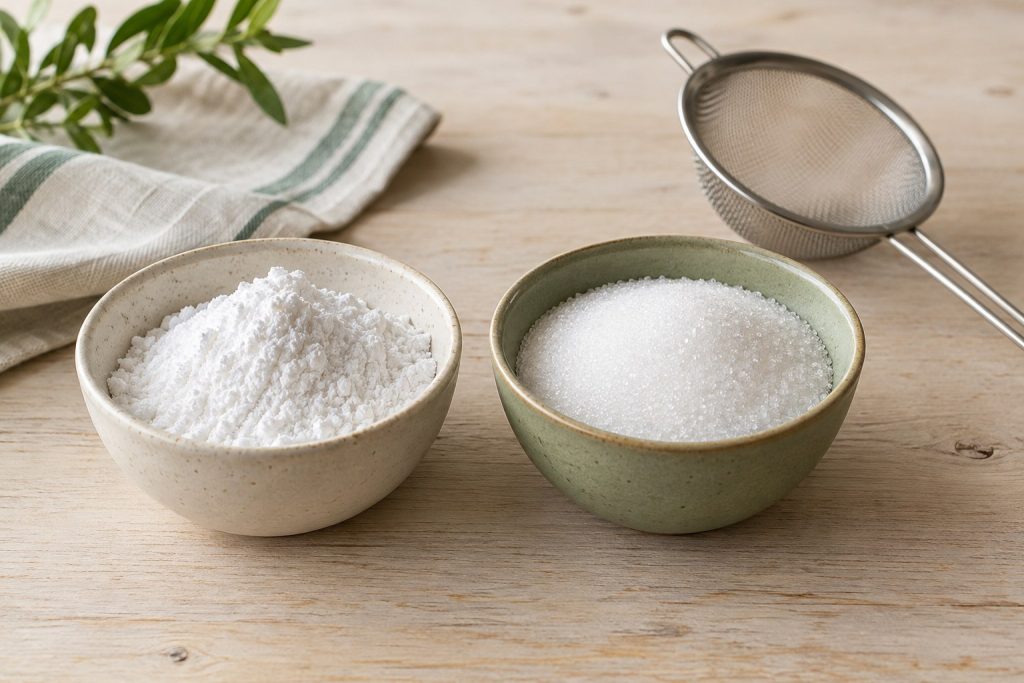
Read the ingredient and texture together
King Arthur describes confectioners’ sugar with added cornstarch and explains its use in smooth icings and glazes. Check your own package, since product formulations differ. Do not confuse powdered sugar with a finer grade of still-granulated sugar.
Respect the mixing method
A recipe that creams granulated sugar with butter depends on more than sweetness. King Arthur notes that powdered sugar lacks the defined crystals used in that process. Changing sugar form can therefore change texture; it is not automatically a neutral swap.
Keep the measurement basis
If the recipe supplies a weight, use that weight for the specified ingredient. Equal cups or spoonfuls of differently textured sugars need not represent equal masses. Matching weight alone still does not guarantee identical baking behavior after a substitution.
Use a tested alternative
Prefer the recipe author’s substitution guidance, especially for doughs and frostings. Sifting instructions and the order of weighing matter too, so read the whole method. Record the product and any change before judging the result or repeating the bake.
Sources
Related reading
About this article: an introductory editorial draft. Not yet independently reviewed by a fitness professional.