Swimming Laps and Pool Distance: Count Lengths Without Confusion
To calculate swimming distance, multiply the number of pool lengths by the distance from one end to the other. Check whether the pool is measured in yards or meters. Because people use “lap” differently, counting one-way lengths and recording the unit is the clearest approach.
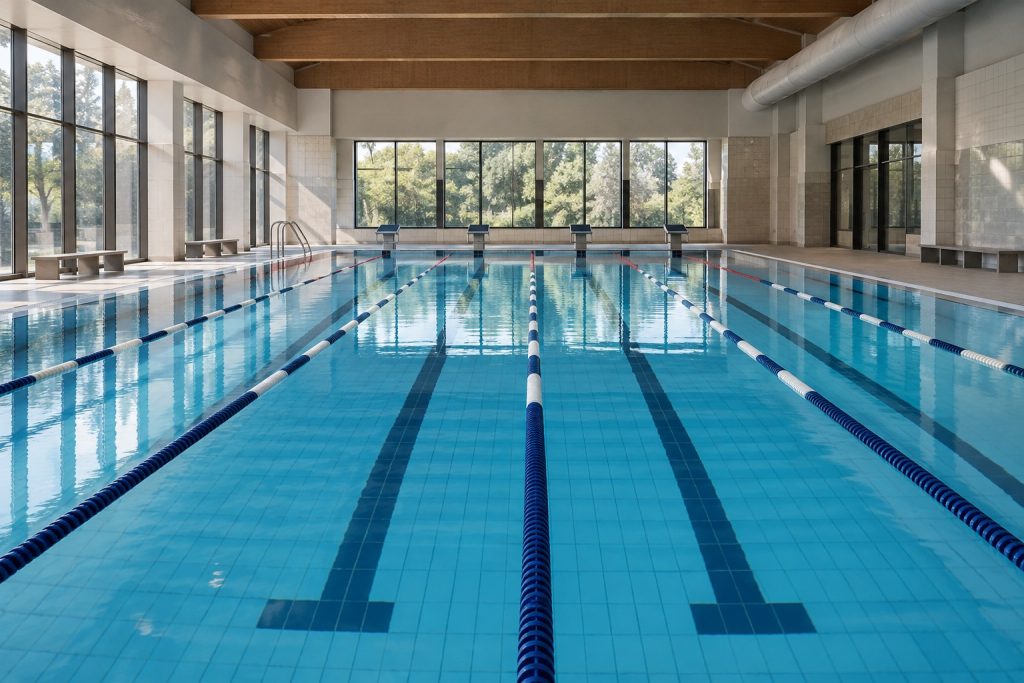
Is a lap one length or two?
A length is one trip from one end of the pool to the other. “Lap” can mean that same trip or an out-and-back pair. U.S. Masters Swimming notes this difference in usage and recommends clarifying the coach’s terminology.
Before following a workout or comparing totals with a friend, agree on the definition. Writing “20 lengths in a 25-meter pool” removes the ambiguity that remains in “20 laps.”
How do you calculate the distance?
Total distance = completed one-way lengths × pool length. Keep the same unit throughout the calculation. The arithmetic examples below show why the number of lengths alone is insufficient.
| Pool length | One-way lengths | Total distance |
|---|---|---|
| 25 yards | 20 | 500 yards |
| 25 meters | 20 | 500 meters |
| 50 meters | 20 | 1,000 meters |
| 20 meters | 20 | 400 meters |
For a 1,000-meter target in a 25-meter pool, divide 1,000 by 25: you need 40 lengths. If you personally call an out-and-back a lap, that is 20 of those laps. State the distance anyway.
How do you find your pool’s length?
Check the facility information or ask staff. Do not infer the length from the appearance of the building. U.S. Masters Swimming describes 25-yard, 25-meter, and 50-meter courses, but recreational pools can use other dimensions.
Yards and meters are different units: one yard is 0.9144 meters. Therefore, 1,000 yards equals 914.4 meters, not 1,000 meters. Label your workout before comparing it with a previous session at another pool.
What does “4 × 50” mean?
It means four repetitions of a distance of 50 in the stated unit, totaling 200. In a 25-yard pool, each 50-yard repetition is two lengths. The notation alone does not tell you how long to rest or which stroke to use; those details belong elsewhere in the plan.
How can you keep a useful record?
Record pool length, units, total distance, and whether your time includes rests. If you use a watch, check its pool-length setting and review unusually large changes rather than accepting every total automatically. Our guide to swimming for fitness helps organize a first session; the pace calculator can help with time-and-distance arithmetic after converting units as needed.
Related reading
Why Your Swim Watch May Miss Kickboard Lengths
Related reading
What Is SWOLF? Read the Swim Score in Context
Record the distance you completed, not just the written set
Suppose a fictional plan says 4 × 100 m in a 25 m pool. Each full repeat needs four one-way lengths. If you finish three repeats and then stop after three lengths of the fourth, the record is:
| Completed work | One-way lengths | Distance |
|---|---|---|
| 3 full repeats | 12 | 300 m |
| Part of repeat 4 | 3 | 75 m |
| Actual total | 15 | 375 m |
The plan was 400 m; the completed distance was 375 m. Write both rather than marking the whole set complete. These numbers illustrate bookkeeping, not a target. Do not continue merely to make the record match the plan.
When a target does not fit whole lengths
In a 20 m pool, 550 ÷ 20 = 27.5 lengths. If your agreed plan uses complete lengths, 27 lengths total 540 m and 28 total 560 m. Decide the adjustment with the instructor and record the chosen distance. Do not report either option as exactly 550 m or treat the arithmetic as an instruction to stop mid-pool.
Keep three details beside the total
- Pool length and unit, checked with the facility; keep yards and metres distinct.
- Completed one-way lengths by block, including an unfinished repeat. If a length count is uncertain, label it uncertain instead of rounding it into a confirmed total.
- Timing definition: swimming time only or elapsed time including pauses. Record stroke, drills and equipment when they change the task.
Converting yards to metres changes the unit, not the swim that happened. It does not predict an equivalent performance in a different pool. For the general pace calculator, convert metres to kilometres by dividing by 1,000; 375 m is 0.375 km. Its pace output is per kilometre or mile, not per 100 m.
Connect the distance record to starts, finishes and the printable swim log
About this article: an introductory editorial draft. Not yet independently reviewed by a fitness professional.