Running Track Laps: Distances, Mile Conversion and Pace Tables
A lap is the length of the route you actually follow. On a confirmed 400 m route, four laps equal 1600 m, a mile is four laps plus 9.344 m, and 5 km is 12 laps plus 200 m. Check the facility, lane and markings before applying these tables.
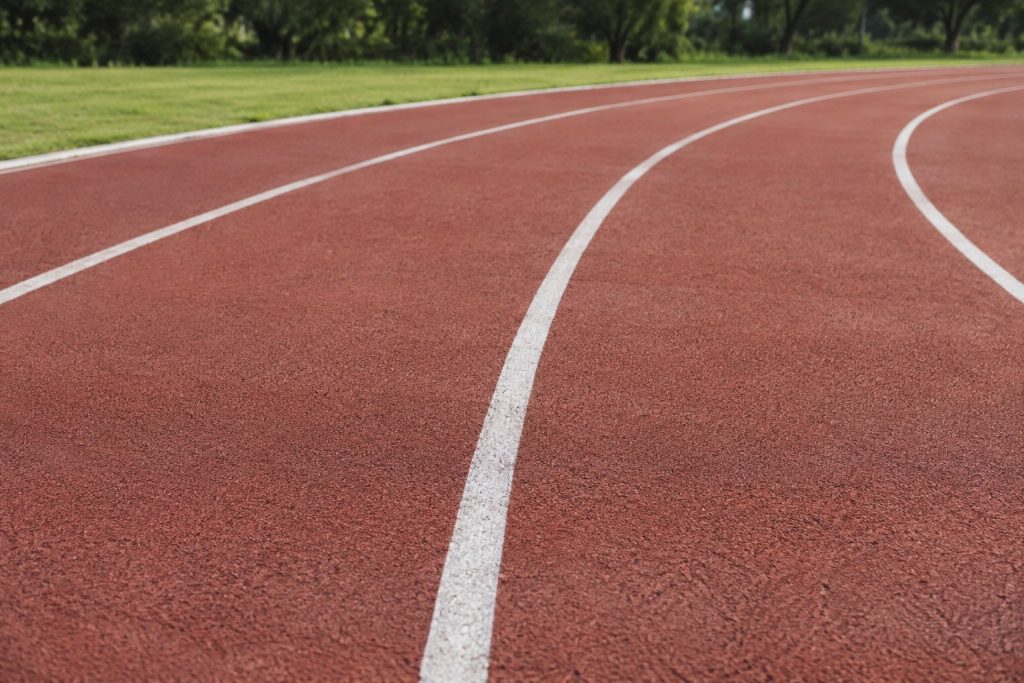
Confirm which route the lap length describes
A standard outdoor athletics track uses a 400 m measured inside route. Smaller indoor tracks, school ovals and park loops may differ. A sign can refer to one lane or one marked route. Ask the operator which length applies to the lane allocated to your activity. Do not take over a reserved lane just to simplify arithmetic.
A lap and a race distance are different questions
A full loop means returning to the same point along the same route. A lane-based 400 m race uses staggered starts to account for wider outer curves. Starting level with another person and completing an outer-lane loop does not reproduce that race setup. The table below assumes a confirmed 400 m route; it is not a table of every lane’s distance.
Distance table for a confirmed 400 m route
Divide the target distance in metres by 400 to get the number of laps. For a practical count, separate complete laps from the remaining metres. For 5 km: 5000 ÷ 400 = 12.5, so 12 full laps cover 4800 m and 200 m remain. Use the facility’s correct markings for the remaining section rather than guessing from the illustration.
| Distance | 400 m laps | Full laps + extra metres |
|---|---|---|
| 200 m | 0.5 | 0 + 200 m |
| 400 m | 1 | 1 + 0 m |
| 800 m | 2 | 2 + 0 m |
| 1000 m | 2.5 | 2 + 200 m |
| 1500 m | 3.75 | 3 + 300 m |
| 1600 m | 4 | 4 + 0 m |
| 1609.344 m | 4.02336 | 4 + 9.344 m |
| 3000 m | 7.5 | 7 + 200 m |
| 5000 m | 12.5 | 12 + 200 m |
| 10000 m | 25 | 25 + 0 m |
Why four laps are slightly short of a mile
The international mile is exactly 1609.344 m. Four 400 m laps total 1600 m, leaving 9.344 m. Four laps are a useful 1600 m distance, but label them 1600 m rather than recording an exact mile. The small difference matters when comparing a timed mile with a 1600 m result. This is a unit distinction, not a reason to distrust a useful workout.
Convert a chosen pace into a lap time
For a 400 m lap, multiply seconds per kilometre by 0.4. A pace of 6:00 min/km is 360 seconds per kilometre: 360 × 0.4 = 144 seconds, or 2:24 per lap. At 10:00 min/km the arithmetic gives 4:00 per lap. These rows are conversions, not recommended walking or running speeds. They assume constant average pace over the measured route.
| Pace (min/km) | 400 m lap (m:ss) | 200 m segment (m:ss) |
|---|---|---|
| 4:00 | 1:36 | 0:48 |
| 5:00 | 2:00 | 1:00 |
| 6:00 | 2:24 | 1:12 |
| 7:00 | 2:48 | 1:24 |
| 8:00 | 3:12 | 1:36 |
| 10:00 | 4:00 | 2:00 |
| 12:00 | 4:48 | 2:24 |
Worked 5 km example: include the final half lap
At 6:00 min/km, twelve full 400 m laps at 2:24 take 28:48. The remaining 200 m takes 1:12, giving 30:00 overall. Do not round 12.5 laps down to 12 and call the resulting 4800 m a 5 km session. You may walk or run a different distance; record what you actually did rather than changing the label.
For a different confirmed lap length, change the denominator
The formula is target metres ÷ lap metres. On a confirmed 250 m loop, 1000 m requires 4 laps and 5000 m requires 20. A 400 m pace table does not directly apply to that loop. If the lap length is uncertain, track duration and describe the route rather than reporting a precise distance from an assumed 400 m.
Make the count easy to reconstruct
Choose a permitted reference line and write down whether you are counting completed laps or laps remaining. If you use a manual lap button, press it at that reference; a missed press may combine two laps into one recorded segment. Keep warm-up, recovery and the main distance distinct in your notes. A watch segment and one physical loop are not automatically the same thing.
Use the existing pace calculator for your own values
Enter the known distance and time to calculate average pace, or choose distance and pace to calculate duration. Keep moving time separate from elapsed time if stops are involved. For a track log, record the facility, lane or route, stated lap length, full laps, extra metres, timing method and interruptions. The calculator does not confirm the track measurement or predict how the session will feel.
World Athletics — 400 m · USATF New England — 5000 m · NIST — 1609.344 m
Related guides and calculator
- Pace, speed & finish-time calculator
- Walking & Running: Pace Tables and Planning Tools
- Is Every Lane of a Running Track 400 Metres?
- Indoor Track Etiquette for Walkers and Runners
- Moving Time vs Elapsed Time: Which Pace Are You Reading?
- Auto Lap vs Manual Lap: What Is Your Running Watch Recording?
- Run–Walk Interval Planner: Total Time and Session Schedule
About this article: an introductory editorial draft. Not yet independently reviewed by a fitness professional.