How to Read a Pool Pace Clock
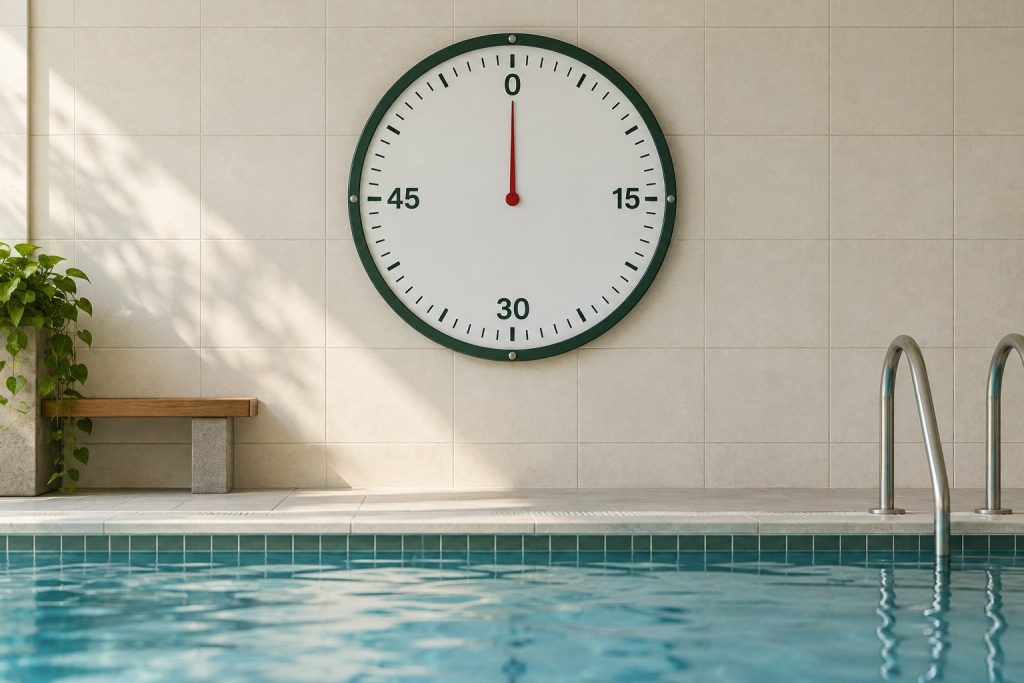
A pool pace clock helps swimmers follow elapsed time and planned start times. On a typical analog clock, the seconds hand completes a lap every 60 seconds. First identify which hand shows seconds and whether the clock also tracks minutes.
What do top and bottom mean?
In common swimming language, leaving on the top means starting when the seconds hand reaches the top of the face, equivalent to :00 on a digital display. Leaving on the bottom means starting at :30. A coach may use a different colored hand, so ask which hand to follow before the set begins.
How do you time a swim across the top?
If you leave at 50 and finish at 20, the elapsed time is 30 seconds only if the swim took less than a minute. For longer swims, count complete minutes as well. Write down the start point if necessary; the final position of a seconds hand alone cannot tell you how many laps of the clock have passed.
What is the difference between a send-off and rest?
A send-off includes swimming and recovery. For example, starting every 1:30 and swimming for 1:10 leaves 20 seconds before the next start. An instruction to rest after finishing instead begins the rest period at your finish. These are different ways to organize a set, even when the written numbers look similar.
How can a beginner practice?
Try reading the clock from the end of the lane before swimming. Confirm the start point and interval with the coach or lane group, then practice with an easy repeat. Give other swimmers space at the wall. If you miss a start or lose the count, clarify the next departure rather than rushing into someone’s path.
Sources
Related reading
Lap-Swimming Etiquette: How to Share a Pool Lane
Swimming Laps and Pool Distance: Count Lengths Without Confusion
Related reading
Swim Workout Rest vs Send-Off: When Do You Start Again?
The same clock position can mean different swim times
A seconds hand shows where you are within a minute. It does not tell you how many minutes have passed. In the examples below, 0:50 means minute 0, second 50 on a clock reference chosen for the exercise; it does not mean 50 seconds since the swimmer started.
| Full finish reading | Times past :00 since start | Elapsed swim time |
|---|---|---|
| 1:20 | 1 | 0:30 |
| 2:20 | 2 | 1:30 |
| 3:20 | 3 | 2:30 |
These three finishes look identical on a seconds-only display. With the minute count known, elapsed seconds = 60 × number of crossings of :00 + finish seconds − start seconds. For the second row: 60 × 2 + 20 − 50 = 90 seconds. A crossing of :00 is a minute boundary, not necessarily a full 60 seconds of swimming: the first crossing after :50 happens only 10 seconds later.
If you lost the minute count, write “time unknown” rather than choosing the shortest possible answer. Finishing on the same seconds mark could mean 1:00, 2:00 or longer, not automatically zero. A separate minute display or a recorded stopwatch duration can resolve the uncertainty; the seconds mark alone cannot.
Practise departures that move around the clock
For a fictional start every 1:15, beginning at 0:35, add the full 75 seconds each time. This is an arithmetic practice, not a suggested swim set. The last column is time since the first departure.
| Start number | Full clock reading | Time since first start |
|---|---|---|
| 1 | 0:35 | 0:00 |
| 2 | 1:50 | 1:15 |
| 3 | 3:05 | 2:30 |
| 4 | 4:20 | 3:45 |
The seconds marks are :35, :50, :05 and :20, but these starts are 75 seconds apart, not 15. Between 1:50 and 3:05 the clock passes :00 twice. Following only the next matching mark would start too soon. Keep the minute count and the departure number together.
Three checks before recording a timed swim
- Confirm the hand or display to follow, the starting mark and who is tracking minutes. On a clock with several coloured hands, keep using the agreed hand.
- Separate full clock readings from elapsed durations in your notes. If you restart the timing reference or change clocks, label that change; do not subtract readings from unrelated references.
- Record actual start and finish, or an independently measured duration, plus any missing count. Confirm the next departure with the coach or lane group if you lose track.
Use the printable start-and-finish record and its worked swim schedules
Clock terminology: U.S. Masters Swimming (English). The tables are original arithmetic examples; they do not estimate swimming speed or prescribe recovery. U.S. Masters Swimming.
About this article: an introductory editorial draft. Not yet independently reviewed by a fitness professional.