How Many Reps Should You Do to Build Muscle?
There is no single repetition count that uniquely builds muscle. Both lighter and heavier resistance can produce muscle growth. A moderate range such as 8–12 reps is a useful way to organize a routine, but the challenge of the set, exercise technique, and progression matter alongside the number.
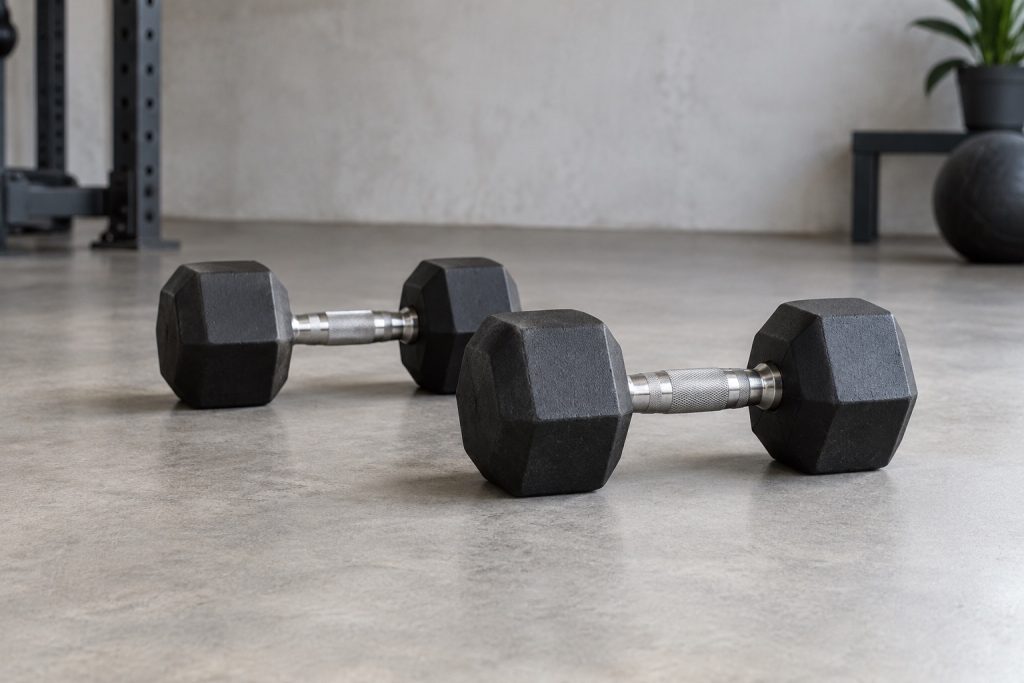
Is 8–12 reps the best range for muscle growth?
A 2021 systematic review of 45 studies found similar muscle growth with higher and lower loads, while higher loads produced greater improvements in one-repetition maximum strength. This distinction matters: becoming better at lifting a very heavy weight and increasing muscle size are related, but different, outcomes.
A 2023 network meta-analysis also found that multiple resistance-training prescriptions increased muscle size compared with no training. Its highest-ranked strength prescriptions used heavier loads; its highest-ranked muscle-growth prescriptions included multiple sets. Neither analysis establishes one exact rep count as a universal winner.
How should a beginner choose a rep range?
Start with the range in a coherent beginner program. Treat it as a repeatable instruction, not a biological boundary. If the plan says 8–12, the immediate task is to use an appropriate load, complete controlled repetitions, and record what happened. See what sets and reps mean if the notation is unfamiliar.
| Plan notation | What to record |
|---|---|
| 3 × 8–12 | Three separate repetition counts, plus the load |
| 2 × 15 | Whether both sets reached 15 with the intended technique |
| 8 reps with 2 in reserve | The completed reps and estimated remaining capacity |
These are examples of reading a program, not three competing prescriptions. A rep target without an exercise, load, and effort instruction is incomplete. Twelve easy repetitions with a weight you could lift many more times do not describe the same task as a challenging set of twelve.
Do you have to reach failure?
Do not interpret a rep range as permission to sacrifice technique to hit a number. Follow the program’s stopping rule and learn how it defines a completed repetition. Repetitions in reserve describes estimated remaining capacity; our guide to training to failure examines the evidence separately.
If you stop because your grip slips, your balance changes, or the setup becomes unstable, write that down. It is useful information, but it is not automatically a measurement of the target muscle’s capacity. Choose a setup you can control and seek instruction when a movement is unfamiliar.
How can you progress within a rep range?
Here is a record-keeping example for a program using three sets of 8–12: one session might be 10, 9, and 8 reps at the same load. A later comparable session might be 11, 10, and 9. The second record shows more completed work without requiring a new exercise every visit.
When to increase load depends on the program’s progression rule. If it calls for a small increase after all sets reach the upper target at the intended effort, follow that rule rather than inventing a new threshold each session. Keep rest periods and exercise setup reasonably consistent when comparing results. See progressive overload and workout logging.
Common questions about reps
Are high reps only for “toning”?
No. “Toning” is not a separate repetition zone established by the research above. Describe the actual goal—muscle size, strength, or another outcome—before choosing a routine.
Should every exercise use the same range?
Not necessarily. A program can assign different ranges to different movements. Keep the instructions specific to each exercise instead of copying one number across the entire session.
How much time will the sets take?
Repetitions alone cannot answer that. Use the workout duration calculator to include set time, rest, preparation, and transitions.
About this article: an introductory editorial draft. Not yet independently reviewed by a fitness professional.